About Parapercis hexophtalma (Cuvier, 1829)
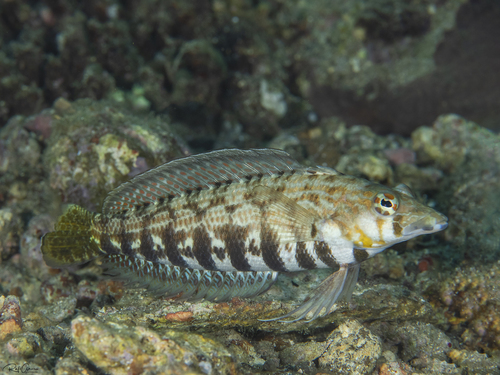
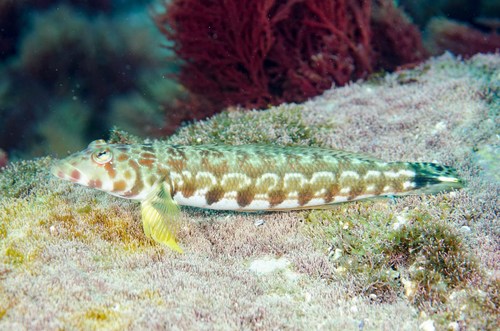
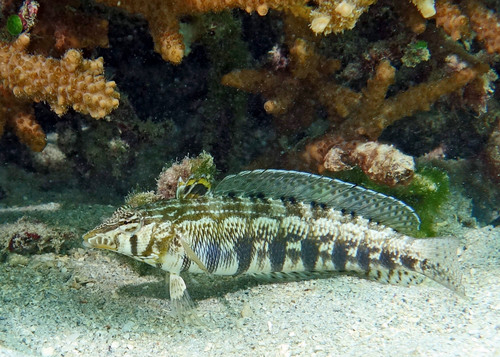
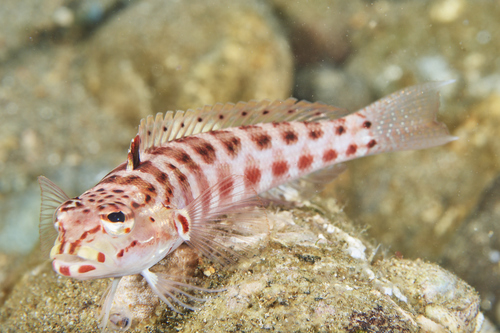
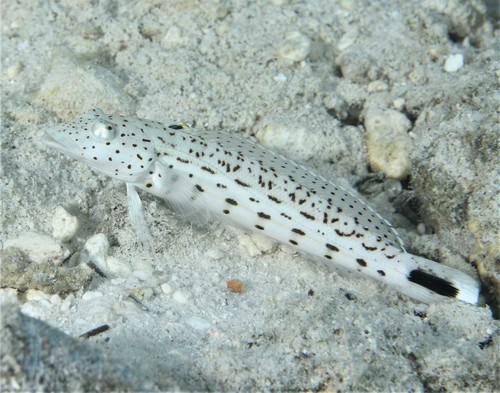
The speckled sandperch, with the scientific name Parapercis hexophtalma (Cuvier, 1829), reaches a total length of roughly 28 centimeters (11 inches), and its body length is approximately five times its body depth. The front portion of its body is cylindrical, while the rear portion is somewhat flattened. Its eyes are positioned fairly close together on the top of the head. This fish rests on the seabed, propped up by its widely spaced pelvic fins. Its dorsal fin contains five spines plus 21 or 22 soft rays, and its anal fin contains one spine plus 17 or 18 soft rays. The dorsal surface of the body is greenish, dappled with dark brown; the flanks are pale grey, and the underparts are white. A lateral row of large white spots runs along the flank, each of which contains one or more small black spots in its center. Additional black spots, most edged with yellow, are present on the underparts. Females have brown spots on the head, while males have diagonal yellowish-brown markings on the cheek. The dorsal fin has a black spot at the base of its spines, and the caudal fin—either rounded or with a short extension from the upper lobe—has a larger black spot. Several rows of small black spots appear on the soft rays of the dorsal fin, and one row of these spots appears on the anal fin. The speckled sandperch is distributed in shallow waters along the east coast of Africa as far south as Natal, in the Red Sea, and throughout the western Indo-Pacific. Its range extends east as far as Sumatra, and includes the Maldives, the Laccadives, and Sri Lanka. The type locality of this species is the Red Sea. While its range was originally believed to extend east as far as Fiji, three new Parapercis species were recognized in 2007, distinguished by fin ray counts, colouration, markings, and the location and number of spots on the anal fin. Parapercis pacifica occurs from southern Japan to the Timor Sea, Parapercis queenslandica occurs off northern Australia, and Parapercis xanthogramma occurs in Fiji, Tonga, and Western Samoa. The speckled sandperch typically inhabits sandy or rubble substrates in sheltered areas near reefs.