About Parapercis colias (Forster, 1801)
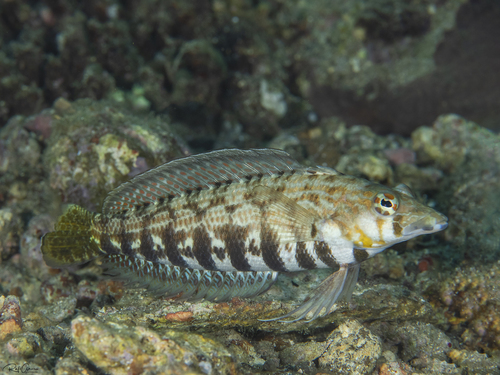
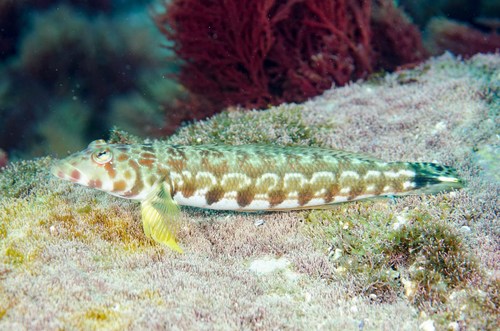
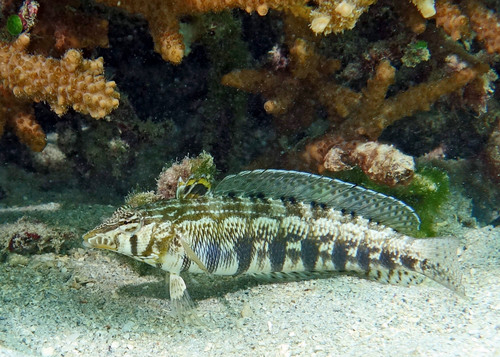
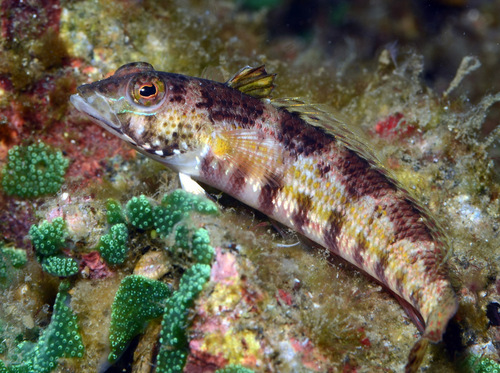
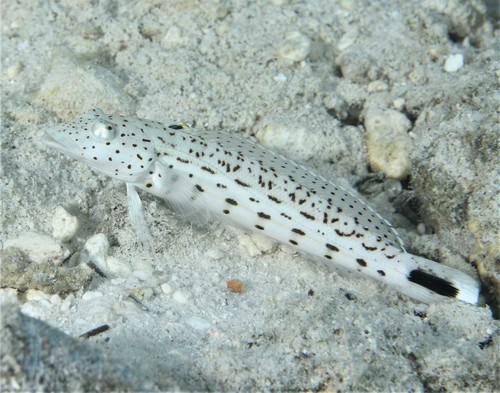
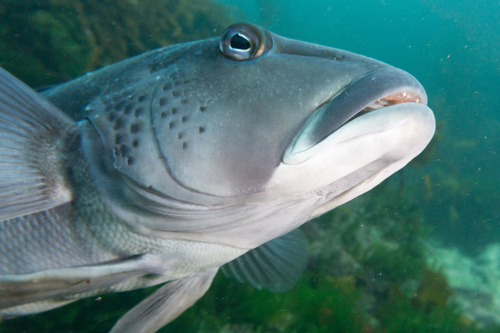
Parapercis colias are protogynous hermaphrodites: they begin life with both female and male reproductive organs, and some females change sex to males later in life. This is a marine bottom-dwelling fish found in coastal New Zealand waters. Its colouring varies by age and sex. Juveniles are generally pale and have two long dark stripes along the sides; these stripes turn brown and become barely distinguishable when the fish reach medium size. When individuals mature past 25 cm in body length, both sexes have a blueish-grey dorsal side and a white underside. Females have an orange tinge, and tend to become green as they grow larger. Brownish pigment is present at the base of the pectoral fin. In contrast, adult males have a distinctive blue-grey overall colour, greenish sides, and a golden brown line above each eye. The typical body length of P. colias is 30–40 cm, though it can reach up to 60 cm. Its typical weight is 0.8–1.5 kg, though it can reach up to 3 kg. Males tend to be larger than females, and this species can live up to 32 years. The head of P. colias is prominent, rounded, and covered in scales. It has a plump body covered with firm scales. Two large lateral eyes sit above non-expanded cheeks, and can rotate independently, allowing the fish to see in almost all directions around it. P. colias has a terminal mouth with bulbous lips. Its pelvic fins are typically positioned forward on the throat, and brown dots appear underneath these fins. A single horizontal stripe crosses 10 to 12 scales along the side of the body. The anterior section of the dorsal fin is small and short, preceded by five short spines, while the second dorsal fin is long. A key published by Cantwell can distinguish P. colias from other parapercids, with the following key features: the outer row of the lower jaw has eight teeth; dorsal spines grow longer toward the posterior (rear end); soft dorsal fins have 20 rays, and anal fins have 17; 10 to 11 scales are present between the lateral line and the base of the first soft dorsal ray; gill raker counts range from 23 to 26; the caudal (tail) fin has 15 branched rays, and has a rounded but bilobed shape. Detailed osteological (skeletal structure) characteristics of Parapercis species can be found in a work by Gosline. While swim bladders that help fish maintain depth without expending extra energy are usually present in osteichthyids, P. colias lacks a swim bladder. If it stops swimming, it automatically sinks to the sea floor, which is why it is classified as a bottom-dwelling or sedentary bottom-hugging species; its flattened abdomen also reflects this bottom-dwelling lifestyle. P. colias typically uses its pectoral fins to swim; body muscles and the tail fin are only used for sudden bursts of speed, a swimming style called labriform. As a result, its pelvic fins are reduced and thickened, and are used as props when the fish rests on the seabed. Because it is bottom-dwelling, sand can clog its gills while it rests. To fix this, P. colias often holds its breath and opens its mouth for long intervals, yawning to take large gulps of water every so often. Upon close inspection, P. colias has no palatine teeth and only small teeth in the mouth, but its prey would feel the sharp, well-developed pharyngeal teeth located near the throat. Additional detailed internal morphological characteristics that determine this species’ taxonomy, such as the presence of a lentiform body, an ocular vascular structure, are outlined by Eastman. Pinguipedid fishes (sandperches) are widely found across the southern Atlantic and Indo-Pacific regions, but P. colias is endemic to New Zealand. Within New Zealand, P. colias occurs from the shore to the shelf edge around the entire country’s coastline, with no records from the Kermadec Islands or the Snares Islands. It is more abundant south of Cook Strait, and is an iconic species for the South Island, being most common around Southland and the Chatham Islands. P. colias can be found at depths down to 150 m, occupying bedrock outcrops on gravel or sandy seabeds; it particularly prefers habitats that also host macro algae or sponges. Population abundance in different habitats varies by age. Juveniles are found more often in sponge gardens deeper than 16 m, dominated by orange finger sponges (Raspalia topsenti & Raspalia flaccida), large black massive sponge (Ancorina alata), and the small bright yellow clumps of Polymastia granulosa, which provide extra shelter and safer refuges. Adults are mainly found on reef margins and in deeper areas. As a feeding generalist that preys on a wide range of species rather than relying on a single prey type, P. colias also favors habitats with high species diversity, such as kelp forests established on rock beds. However, it can also be found in less diverse habitats including barren rock flats 4–12 m deep, which are dominated by sea urchins grazing on algae. While P. colias is typically found at depths up to 150 m, it has been recorded caught at 350 m below the surface. Water depth influences temperature, salinity, and oxygen content; measurements of these environmental ranges for P. colias from 766 collected samples are listed below.