About Parantica nilgiriensis (Moore, 1877)
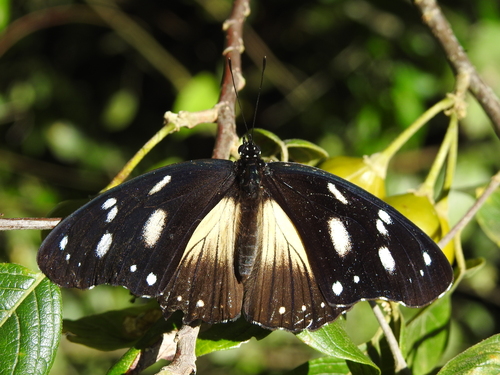
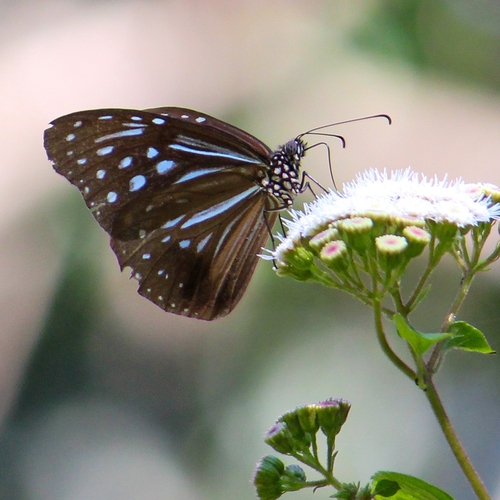
This species has the scientific name Parantica nilgiriensis (Moore, 1877). The upperside of its wings is fuliginous black with bluish-white markings and spots. On the forewing, two streaks sit in interspace 1, coalescing at the base and generally at their apices. A narrow streak sits in the cell, with two faintly indicated streaks above it. There are five discal spots, and above these a long streak in interspace 5, and a shorter streak in interspace 6. Some coastal spots and subterminal and terminal series of spots are present: the subterminal series curves inwards opposite the apex of the wing, with its four lower spots conspicuously larger than the others; the terminal series is incomplete, with small spots. On the hindwing, interspaces 1a, 1b, and 1 have narrow streaks, which are double in interspace 1. The cell holds a much broader, outwardly bluntly pointed streak, and beyond this in the interspaces is a radiating series of elongate spots, followed by a subterminal series of smaller spots and a terminal, very incomplete series of dots. The underside is similar to the upperside, but has a browner ground colour and more clearly defined spots. Antennae are black; the head and thorax are black spotted with white; the abdomen is brownish above and dusky white below. The wingspan ranges from 80–90 mm. Both males and females have dull brownish black colouration with dirty white markings on the upper side. Compared to P. aglea and T. limniace, this species has narrower streaks and smaller spots, and its markings are much less extensive than its background. The cells are dark with a pale streak. Males have a patch of scent scales on the hindwing. Eggs are white, shiny, dome-shaped, and ribbed. Eggs hatch on the fourth or fifth day. The first instar is a small, pearly white caterpillar with a prominent black head and dark grey legs. It has small paired tubercles on the second and twelfth segments, which are precursors of future tentacles. The second instar is larger, and develops a purplish ground colour with white, oval and round spots similar to those seen on the mature caterpillar. It has four longitudinal rows of round spots: two dorsal and two lateral rows on each side. All spots in the lateral rows, plus spots on the first two segments and the last three segments, are yellow. It has a pair of small tentacles on the second segment and a pair of tubercles on the twelfth segment. In the third and fourth instars, the basic morphology remains the same, but the caterpillar grows in length and thickness, the tentacles elongate, and the white spots on all segments gradually turn yellow. The fifth instar is about 6–7 cm long, with long, thin, black tentacles on the second and twelfth segments; the first pair is longer. In this stage, all of the white spots in the four longitudinal rows have turned yellow, against a dark purple ground colour. Other smaller spots and short streaks remain grayish white. The caterpillar takes 14–15 days to complete growth before preparing for pupation. The first and second larval instars exhibit a unique behavior called 'silk diving': when alarmed, the caterpillar simply falls downward and hangs from its own silk thread, a protective predator-avoidance strategy seen in some nymphalids, but previously unknown in any danaid. Mature caterpillars rarely show this behavior, and they do not nip the leaf midrib before feeding. The pupa is green with shining silvery and black spots. It hangs freely from the underside of a leaf or twig, and is very similar in appearance to the pupa of the plain tiger Danaus chrysippus. The pupal stage lasts 11–12 days. On the eve of eclosion, the pupa begins to show the pattern of the developing wings underneath, and turns very dark, nearly black, on the night before hatching. This species is found in the hills of Southern India, including the Nilgiris, Malabar, and Travancore.