About Paranomus abrotanifolius Knight
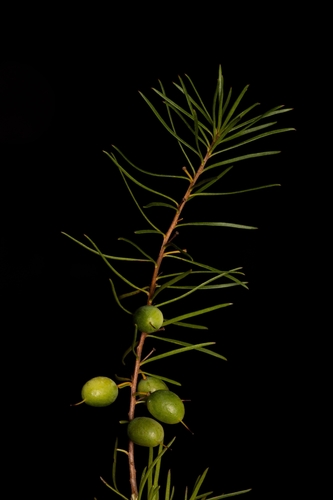
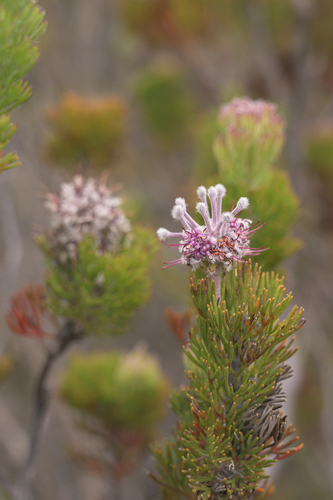
Paranomus abrotanifolius is a heavily branching shrub that reaches up to 90 cm (35 in) in height. Its branches are covered in soft, weak, thin, distinctly separated hairs (a trait called pilose). Leaves are arranged alternately, and all leaves have the same shape, which is unlike the case for some other Paranomus species. Individual leaves are 4–5 cm (1.6–2.0 in) long, twice pinnately divided in the upper half, and lose their soft hairs early in development. Leaf segments end as slender structures that are circular in cross-section with a blunt tip, and grow up to 1¼ cm (½ in) long.
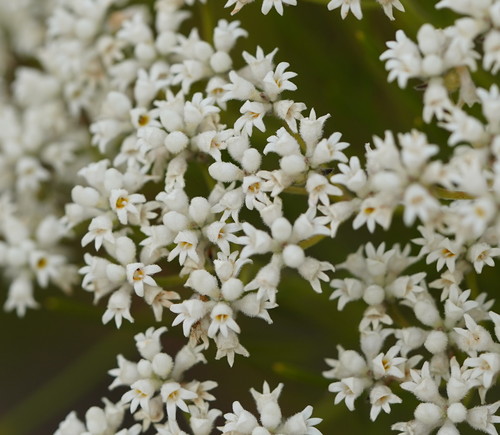
Four flowers are grouped together into heads, and these heads are arranged into dense spikes that measure about 6⅓ cm (2½ in) long and 1¼ cm (½ in) in diameter. Spikes grow singly or in small groups at the tips of branches. The central stem of each spike is covered in felty hairs. Each group of four flowers is subtended by a narrow, awl-shaped bract covered in dense felty hairs, which is about 8½ mm (⅓ in) long. Each individual flower is supported by an almost papery bract that is covered in dense long felty hairs on its outer surface; this bract is about 5 mm (0.2 in) long, 2½ mm (0.1 in) wide, oval in shape, with a gradually pointed tip.
Just before opening, a flower is up to 8½ mm (⅓ in) long. The corolla tube may either have or lack soft short hairs. The four free corolla lobes are 7⅓ mm (0.3 in) long, and coil as the flower opens. Anthers attach directly to the inner surface of the corolla lobes, with no visible filament. The ovary, which is encircled by a ring of hairs, is topped by an 8–10 mm (0.31–0.39 in) long style that has few soft hairs on its lower half. At the top of the style, it gradually tapers to an elliptic, more or less blunt stigma that is about ¾ mm (0.03 in) long. The genus Paranomus is consistently placed in the subtribe Proteinae, which has a basic chromosome number of twelve, with 2n=24 for the species.