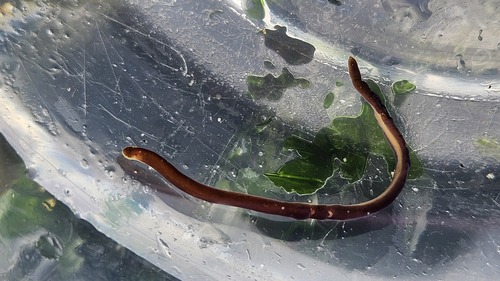
About Paranemertes peregrina Coe, 1901
Paranemertes peregrina Coe, 1901 is usually dark on its dorsal surface, with brown or purple coloration. Its ventral surface is lighter, giving the worm an overall peach-colored appearance. This species is easily recognizable by its distinctive external features and spiral-shaped stylets. The stylets have spirally wrapped grooves on their shafts and grow within vacuoles. Like annelids and mollusks, P. peregrina undergoes spiral cleavage and produces trochophore larvae. During development, individuals transition from a swimming lifestyle to crawling in approximately ten days. Nemerteans typically have either Anoplan or Enoplan morphology, and P. peregrina has Enoplan morphology. This species has been observed in the Pacific Ocean, ranging from the Aleutian Islands to Ensenada, Baja California. It occurs in intertidal habitats in both muddy and rocky bays. P. peregrina feeds exclusively on live or dead polychaetes, and digestion occurs both inside and outside of cells. Food is broken down in an acidic environment by specialized cells that use enzymes including peptidases, carbohydrases, and lipases. After partial digestion of the meal, it is taken up by cells and fully broken down with additional enzymes, which shifts the pH from acidic to alkaline. The species' specific epithet "peregrina" was inspired by the worm's movements across intertidal flats while searching for prey. The feeding process begins when the worm's head recoils after contacting prey; the species does not locate prey via distance chemoreception, relying instead on direct contact. Next, the proboscis is extended and wraps around the prey, causing temporary paralysis or death of the prey. Finally, the prey is swallowed through suction created by muscles surrounding the mouth. The worm eliminates waste between 12 and 33 hours after feeding. The entire feeding process lasts seven to eight minutes from successful initial contact with prey. After feeding, P. peregrina returns to its burrow along its original path, following the mucus trail it left when departing.

