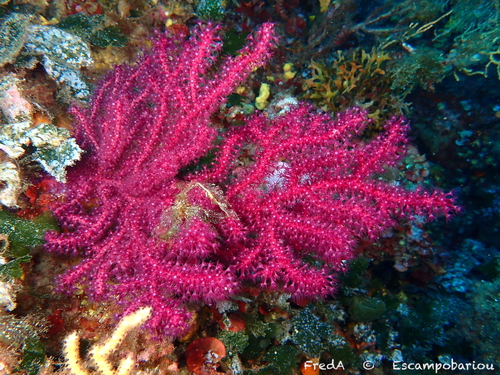
About Paramuricea clavata (Risso, 1827)
Paramuricea clavata (Risso, 1827), commonly called the violescent sea-whip, has a branching structure that forms a single-plane fan-shaped colony. Its stem and branches are stiffened by gorgonin, a complex protein that forms a horny skeleton. A thin living cell layer called the coenenchyme covers the skeleton, and polyps protrude from this layer. Each polyp has eight feeding tentacles that surround a central mouth. Polyps can grow up to 10 mm (0.4 in) high, while the whole colony can reach up to 1 m (3 ft) high and 1 m across. The colony is most often red, but may be partially yellow. The violescent sea-whip is native to the eastern Atlantic Ocean coasts of Spain and Portugal, and to the western Mediterranean Sea. It grows on reefs, with its base buried in sediment. It can be found at depths between 10 and 100 m (33 and 328 ft), but most commonly occurs between 15 and 40 m (49 and 131 ft). This species is classed as an ecosystem engineer because its presence changes water flow, alters sedimentation rates, and shifts nutrient distribution, in turn affecting many organisms living near it.

