About Paramesotriton hongkongensis (Myers & Leviton, 1962)
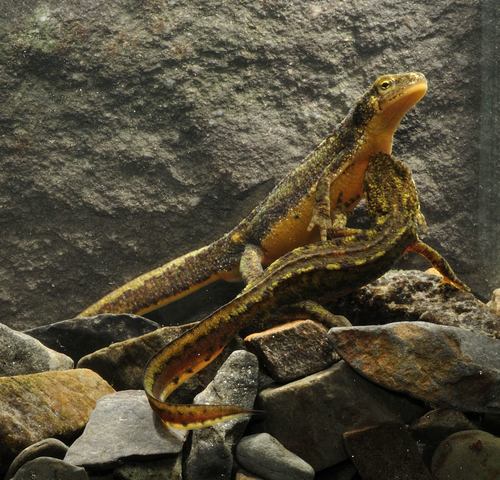
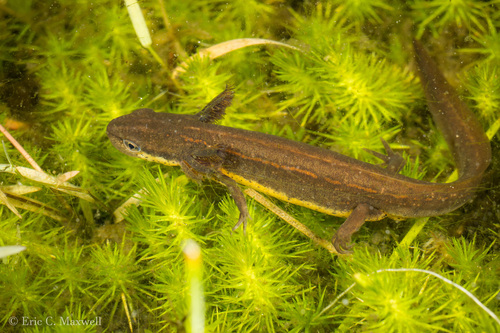
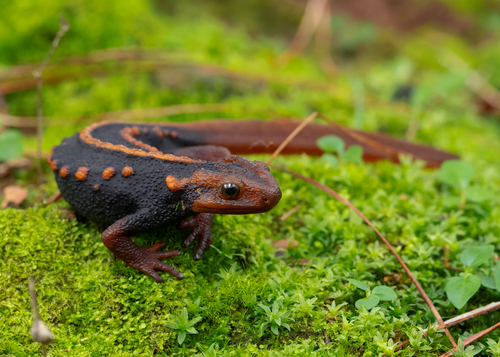
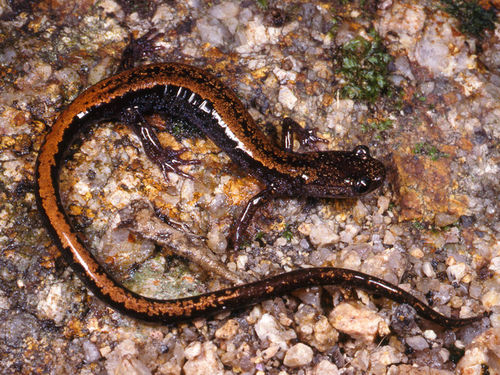
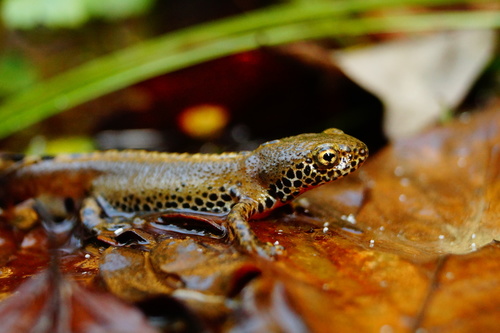
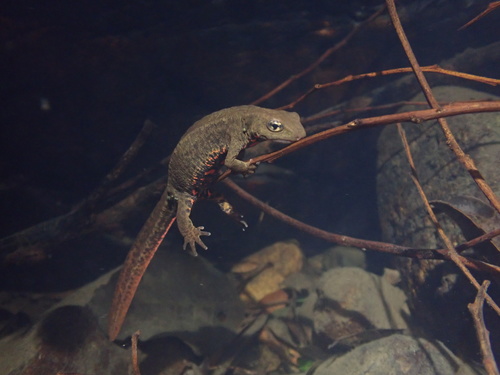
This newt species, Paramesotriton hongkongensis, has a total snout-to-tail length of approximately 11 to 15 cm. Its body colour ranges from light to dark brown, and scattered orange markings appear as patches on its ventral side. Each individual has a unique pattern of these orange patches, similar to human fingerprints. Small granules cover the entire body. A mid-dorsal skin ridge runs backward from the neck through the anterior third of the tail, and two dorsolateral folds are also present. The head is roughly triangular, and the eyes have horizontal pupils. The tail is thin and flattened, with a thin red stripe along its ventral border. All four legs are similar in size. The anterior limbs have four unwebbed digits, while the posterior limbs have five unwebbed digits. Like other newt species, Paramesotriton hongkongensis tadpoles have finger-like gills around their necks, which disappear completely once metamorphosis is complete. When threatened, this newt releases a toxic secretion and may also feign death by rolling onto its back to expose its brightly coloured belly. During the breeding season, males court females by beating their tail; a white or bluish stripe develops on the male's tail, which is visible in dim light. Males transfer sperm to females inside a spermatophore. Females lay eggs one at a time, and wrap each individual egg in leaves.