About Paralithodes camtschaticus (Tilesius, 1815)
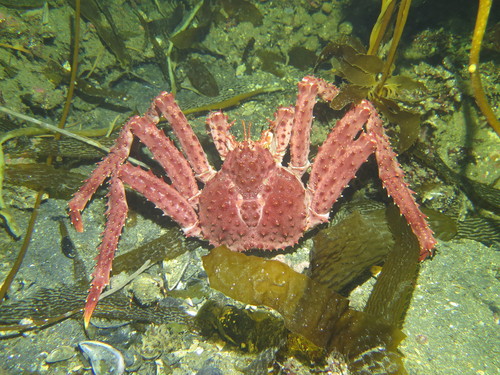
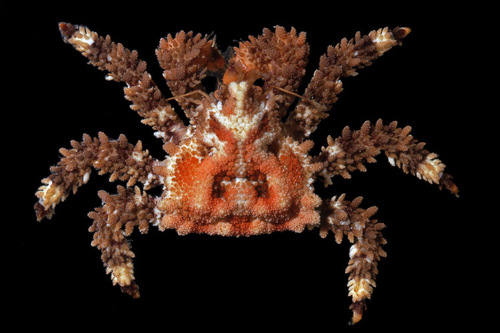
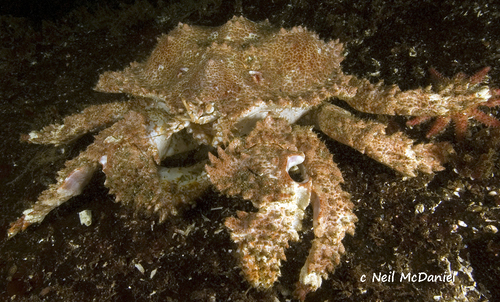
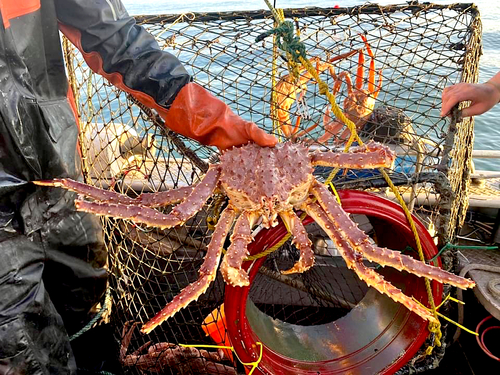
Paralithodes camtschaticus, commonly called the red king crab, is the largest species of king crab. Red king crabs can grow to a maximum carapace width of 28 cm (11 in), a leg span of 1.8 m (5.9 ft), and a weight of 12.7 kg (28 lb), and males grow larger than females. In modern times, red king crabs rarely grow larger than 17 cm (7 in) in carapace width; the average male caught in the Bering Sea weighs 2.9 kg (6.4 lb). The species gets its name from the color it turns after cooking, not the color of a living individual, which is typically more burgundy. The red king crab is native to cold waters of the North Pacific Ocean and surrounding seas. Its native range extends from the Bering Sea south to the Gulf of Alaska, and also includes waters off the Kamchatka Peninsula, the Sea of Okhotsk, and the Sea of Japan. In the 1960s, the Soviet Union artificially introduced this species to Murmansk Fjord in the Barents Sea, to establish a new valuable commercial fishery in Europe. Red king crabs have been recorded in water temperatures ranging from −1.8 to 12.8 °C (28.8–55.0 °F), with their typical habitat temperature falling between 3.2 and 5.5 °C (37.8–41.9 °F). Juvenile red king crabs prefer habitats with temperatures below 6 °C (43 °F). The depth a red king crab lives at depends on its life stage: newly hatched zoea larvae stay in shallow waters, where food is abundant and they can find more protection. After reaching two years of age, crabs typically move down to depths of 20–50 m (66–164 ft), where they form tight, highly concentrated groups of hundreds of crabs in a behavior called podding. Adult crabs are usually found on sandy and muddy substrates at depths greater than 200 metres (656 ft). They migrate to shallower depths to mate in winter or early spring, but spend most of their lives in deep waters feeding. In its native range, P. camtschaticus has many predators. These include Pacific cod, walleye pollock, rock sole, flathead sole, rex sole, Dover sole (Microstomus pacificus), arrowtooth flounder, elasmobranchs, halibut, sculpin, Greenland turbot, Pacific salmon, Pacific herring, sea otters (Enhydra lutris) and seals.