About Paralichthys californicus (Ayres, 1859)
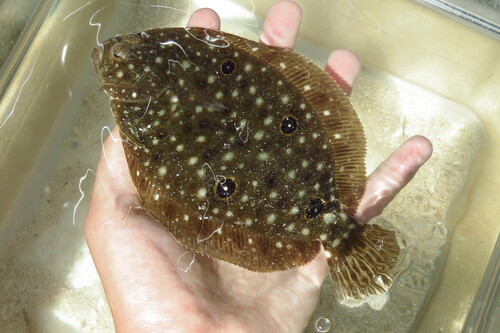
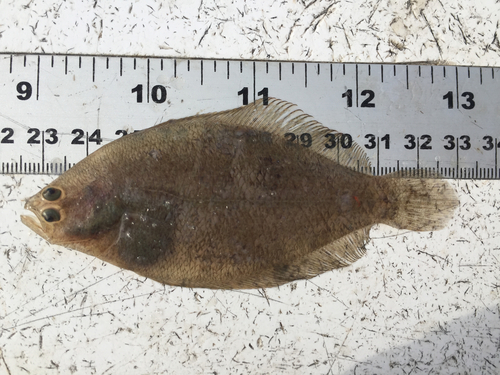
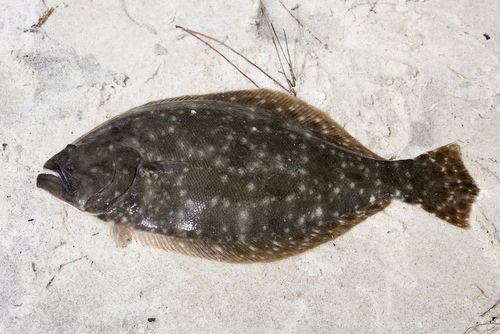
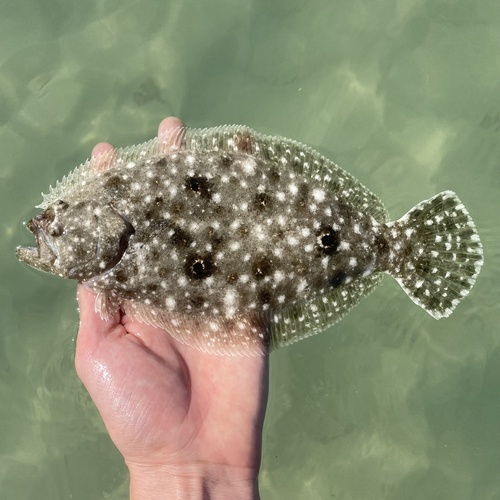
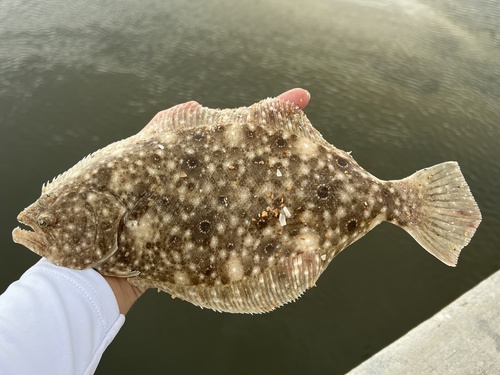
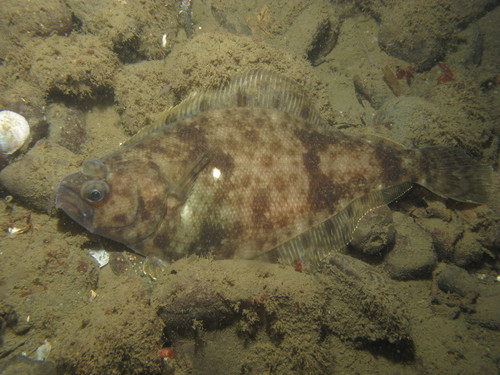
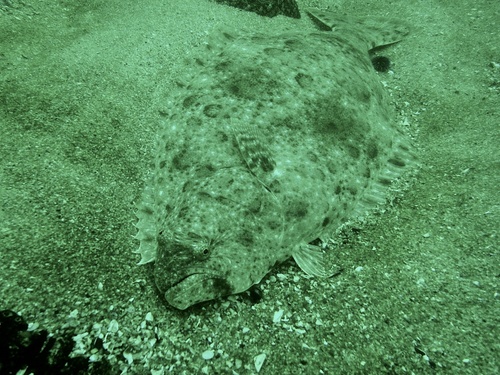
California halibut (Paralichthys californicus) typically weigh 6 to 30 pounds (3 to 23 kg), and the largest individual ever reported weighed 72 pounds (32.7 kg). While it is rare for members of this species to reach 60 inches (1.52 m) in length, their average length ranges from 12 to 24 inches (30 to 61 cm). The largest individuals of this species are always females, because females grow faster than males, who never reach the same large sizes. The legal minimum catch size for both commercial and recreational California halibut fisheries is 22 inches, which corresponds to a weight of around 4 pounds. California halibut take roughly 3 to 5 years of growth to reach this legal size. Like all flatfish, California halibut have an unusual development: one eye migrates from its original position to the opposite side of the head as the fish grows from a larval fry into an adult that lies flat on one side. Adult flatfish end up with both eyes positioned on the upper side of their body that faces away from the seafloor. Unlike most flatfish species, California halibut have no consistent preference for which side the paired eyes end up on, with roughly equal numbers of left-eyed and right-eyed individuals in populations. The base body color of California halibut is grayish brown, marked with darker brown spots. This species can change its body color and pattern to match surrounding substrates, creating excellent camouflage against the benthic mud, gravel, and sand where it lives. California halibut use this camouflage both to avoid predators and to ambush unsuspecting prey. A fish that looks very similar to California halibut is Pacific halibut (Hippoglossus stenolepis), a larger flatfish species found in the northern Pacific Ocean. While Pacific halibut share the same general flat body shape as California halibut, they grow much larger, reaching weights of up to 300 pounds (140 kg). The two species can also be told apart by subtle differences in coloration and eye position, and Pacific halibut live in colder waters than California halibut. The native geographic range of California halibut extends from the Quillayute River in northern Washington, U.S., all the way south to Cabo Falsa (at 22°50'N) in southern Baja California, Mexico. Individuals have also been recorded in the upper Gulf of California. California halibut are most commonly found between Bodega Bay in northern California, U.S. and Bahía de San Quintín in northern Baja California, Mexico. During periodic warm water events, California halibut occasionally become common as far north as Humboldt Bay. Within this range, adult California halibut live on the seabed in shallow water areas, though they have been recorded at depths as great as 317 m. California halibut have a maximum lifespan of around 30 years, but individuals rarely live past 15 years of age, and typically only females survive to reach this older maximum age. Like other flatfish, California halibut go through a unique metamorphosis during their early life stages, changing from symmetric free-swimming larvae to asymmetric bottom-dwelling juveniles. When they first hatch as larvae, California halibut live in the open water column. As they complete metamorphosis, one eye migrates to the opposite side of the head, and the fish shifts to a bottom-dwelling lifestyle. This adaptation lets California halibut move from pelagic open-water habitats to benthic seafloor habitats, where they spend most of their lives. California halibut are broadcast spawners with high fecundity, meaning they produce thousands of young each spawning cycle. Spawning mainly takes place from spring through summer, when mature males and females gather in offshore waters to release their eggs and sperm directly into open water, where fertilization occurs externally. This spawning strategy disperses fertilized eggs over a wide area, which increases the chance that at least some larvae will survive. The peak of the spawning season shifts with latitude: it occurs earliest in the waters off Mexico, and grows progressively later moving north through southern and central California. Although spawning happens in offshore waters outside estuaries, sheltered bays such as San Francisco Bay act as critical nursery habitats where juveniles can grow and mature. California halibut exhibit temperature-dependent sex determination. When larvae develop at 15 °C, the resulting adult population has an even split of females and males. When development happens at higher temperatures of 19 °C and 23 °C, far more individuals develop into males. California halibut can develop as either left-eyed or right-eyed, a trait that is established during metamorphosis around 42 days after hatching, when one eye migrates over the top of the head to the same side as the other eye. Juvenile California halibut that survive this early developmental stage are very resilient, particularly to changes in salinity, though older juveniles tend to have lower tolerance for salinity shifts. Recruitment success, defined as the rate of survival to adulthood, varies substantially between regions. Central California populations see higher recruitment variability than other areas, driven by environmental factors such as upwelling and sea surface temperature that affect larval survival rates. This recruitment variability shaped by abiotic environmental factors is key to maintaining healthy California halibut populations, because low recruitment of new adults can threaten overall population stability.