About Paralabrax clathratus (Girard, 1854)
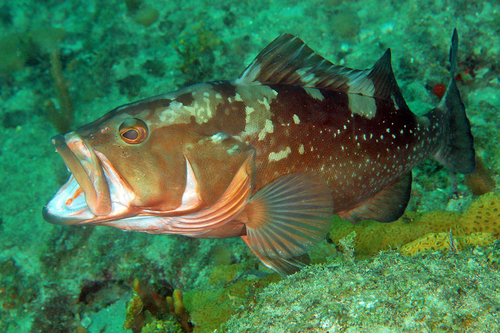
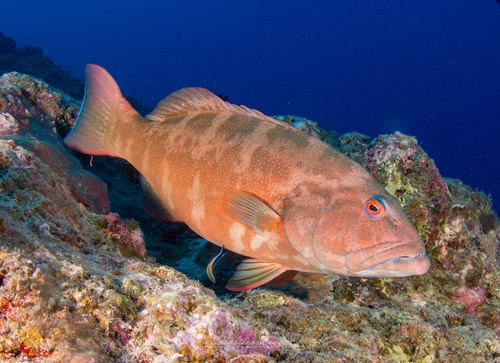
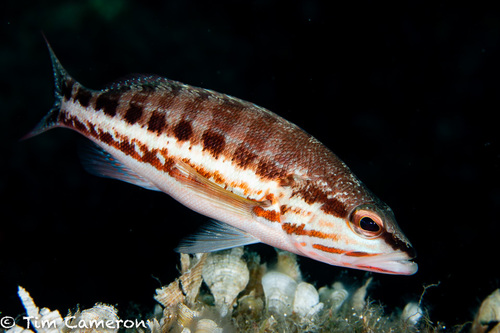
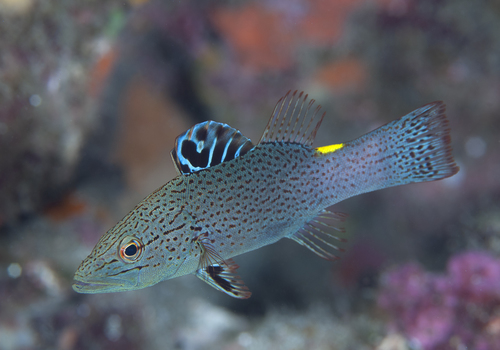
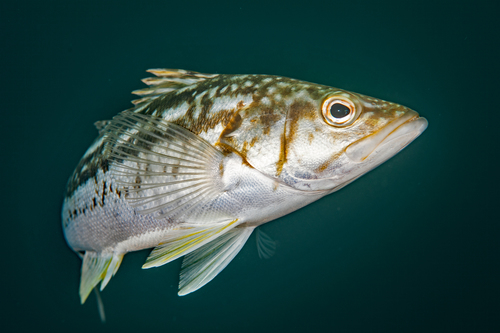
Paralabrax clathratus (Girard, 1854) has an elongated, relatively deep, compressed body with a pointed snout and a large, downturned mouth. The mouth extends back to the center line of the pupil, and the lower mandible protrudes to form part of the snout. Teeth cover the entire roof of the mouth. The margins of the preopercle have fine serrations, and there is a large spine on the edge of the gill cover. The dorsal fin has 10 spines and 13–14 soft rays; the 3rd and 4th spines are the longest, both nearly twice the height of the 2nd spine. The anal fin has 3 spines and 7 soft rays. The caudal fin is truncated, though its margin can be wavy. Juvenile kelp bass are light brown, while adults range from brown to olive-green, fading in color toward the belly. The dorsal part of the head has mottled light yellow spots, and the dorsal body is marked with black, white, and/or olive green blotches. Rows of white, rectangular spots run along the back. All fins have yellow tips. During mating season, males may develop an orange tint on the lower jaw and chin. Kelp bass can change their color to match their surroundings: for example, individuals moving from a kelp forest to the open ocean can change from dark green or brown to pale green. Similar color changes have been observed when kelp bass were artificially moved from their native habitat to study pens. There is no visible sexual dimorphism, so males and females cannot be told apart by sight. Paralabrax clathratus may be similar in appearance to other North American bass species, including spotted bass, white bass, and yellow bass. A feature that distinguishes this species from other sea bass is the piebald or multi-colored spotting under its belly, which is why it is also called calico bass. It is also by far the largest species in its genus. This species reaches a maximum total length of 72 centimeters (28 in) and a maximum published weight of 7.0 kilograms (15.4 lb). Size data collected from entrapment surveys of 38,875 individuals over 39 years shows that approximately 40% of all living kelp bass are 200 to 250 millimeters in length at any given time. Paralabrax clathratus is found in the eastern North Pacific Ocean off the western coast of North America. Its range extends from central California south to the southern tip of Baja California. It formerly occurred as far north as the mouth of the Columbia River on the Oregon-Washington state boundary, but it is now rare anywhere north of Point Conception in California. Paralabrax clathratus occurs at depths between 0 and 61 metres (0 and 200 ft), though it typically stays between 2.7 and 21.3 meters below the surface. It has a strong association with kelp and is almost always found in kelp forests and estuaries, and can also live on nearshore rocky reefs. It uses a variety of micro-habitats within these areas for feeding, shelter, and breeding: for example, juveniles hide among kelp blades and seaweed in the intertidal zone. Adults prefer deeper water, moving into rocky habitats where their larger size gives them some protection from predators. Kelp bass spawn from late spring to early autumn, with the spawning season peaking in summer. During spawning, adults form aggregations that can reach up to 200 fish, though most aggregations number around 50 individuals. Because of these aggregations, kelp bass are most commonly fished during June, July, and August. Virtually none are caught from October through April, when spawning aggregations stop. Aggregations usually form around natural or man-made structures, such as kelp forest canopies or piers, at depths of 8 to 18 metres (26 to 59 ft). Mating fish break off into smaller groups, where a gravid female swims to the substrate and males perform courtship displays by rubbing against her flanks and nibbling her fins. During mating, females change color to dark grey or black on the upper body and bright white on the underparts, while males darken to an overall charcoal color broken by black vertical bars and white spots. Additionally, around 75% of males develop an orange snout during mating season. Males and females release sperm and eggs at the same time, usually spawning between 32 minutes before sunset and 120 minutes after sunset. They can release gametes multiple times in a single evening. There is no known correlation between male size and participation in spawning aggregations. Spawning activity tends to peak each month around the full moon; the reason for this pattern is unknown, though it has been suggested that spawning during full moon-associated high tides may increase fertilization success. After spawning, the eggs hatch within 36 hours. This is followed by a pelagic larval phase that lasts 25–36 days, before the fish settle and transition out of the larval phase to develop into juveniles. Juveniles stay in the kelp forest to protect themselves from predators, and venture further into the open ocean as they mature. For the first 90 days of life, kelp bass grow an average of 0.59 millimeters per day. Most of a kelp bass's growth occurs in the first few years of life, but the species has indeterminate growth. Males reach sexual maturity between 2 and 4 years old, and half of all males are mature at 22 centimetres (8.7 in) in length. Females reach maturity between 2 and 5 years old, and half of all females are mature at 22.6 centimetres (8.9 in). Male and female kelp bass grow in length at the same rate. The maximum recorded lifespan of kelp bass is 34 years, though most individuals do not live nearly that long. Using this maximum age as a reference, studies found that an average of about 17.6 percent of kelp bass die from natural causes each year, not including deaths from fishing. Kelp bass rarely live past age 15 in the wild. To collect data on the growth and life history of Paralabrax clathratus, scientists dove along transects and recorded the number and size of fish they saw within a 3-meter radius. Fish between 1.5 and 2 centimeters in length were classified as newly recruited, fish from 2.1 cm to 10 cm were classified as juveniles, fish from 10.1 cm to 15 cm were classified as subadults, and any fish longer than 15 cm was assumed to be a fully grown adult. This species is largely diurnal, but can remain active both day and night. Individual kelp bass are faithful to their home ranges, which average around 3,000 square metres (32,000 sq ft) and range from 33 to 11,224 square meters in size. Individuals may stay in the same area for up to 3 years. Barren sand channels act as a barrier to their movement. Data on the movement and range of Paralabrax clathratus is collected via acoustic tracking: caught individuals are anesthetized, an acoustic transmitter is inserted between the pelvic fins and vent, the fish are weighed, measured, and tagged for external identification, then released. Tracking is conducted from a small boat equipped with a hydrophone and receiver, and each fish's location is recorded every 15 minutes for up to one month. Younger fish are less site-faithful than older individuals and move greater distances, which may be because their diet changes as they mature. Juveniles are more diurnal because zooplankton, their main food source, is more abundant during the day, and their small size makes them more vulnerable to predation so they take shelter among kelp. Sub-adults are more active at night and have a more diverse diet, as their preferred prey is more active at night. Adult kelp bass feed on small fish, crustaceans, mollusks, and other small primary consumers. In winter, feeding options are much more limited than in summer, and many kelp bass go hungry; when animal prey is unavailable, they sometimes rely on kelp and algae. The primary predator of adult kelp bass is the giant sea bass (Stereolepis gigas), whose population has increased significantly in recent years. Kelp bass are normally solitary, but will form aggregations in pelagic waters, for spawning, and to hunt bait fish as a group. The main prey of juveniles are plankton and small benthic invertebrates, including small crustaceans, brittle stars, and small fishes. Kelp bass of all ages will feed on zooplankton when it is abundant.