About Paragus haemorrhous Meigen, 1822
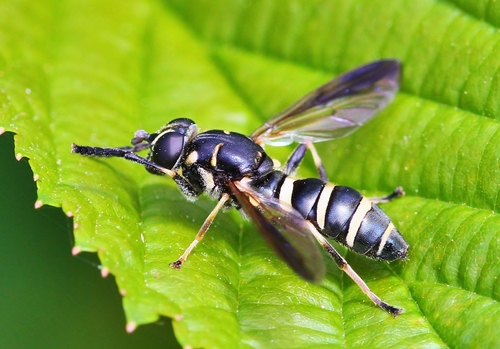
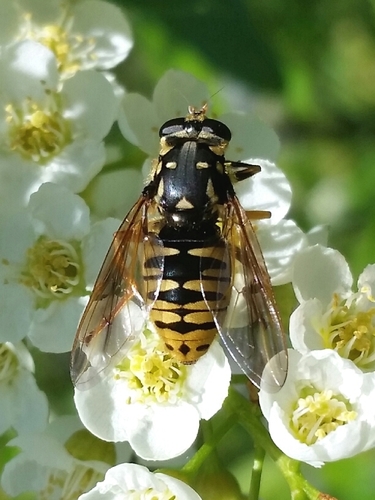
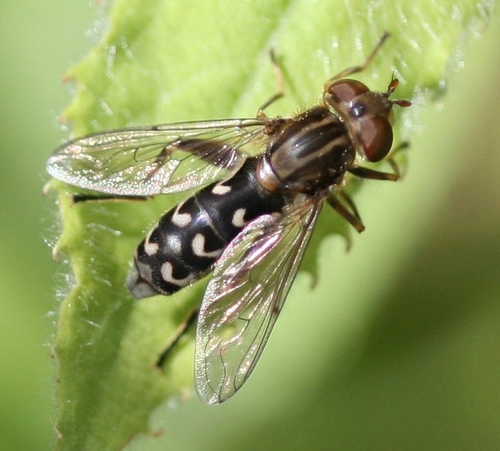
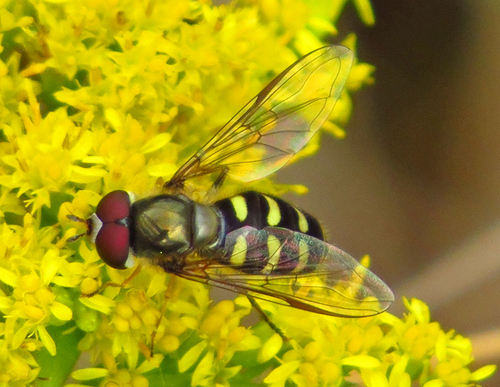
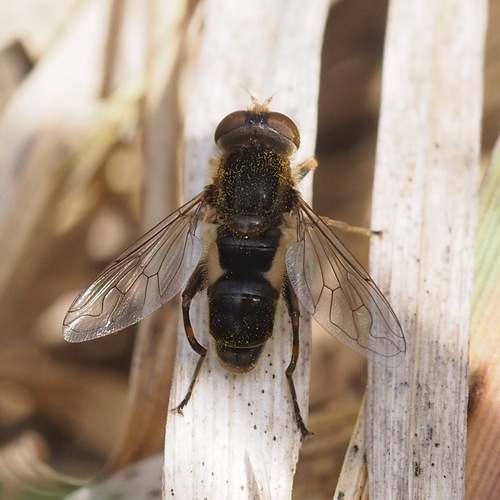
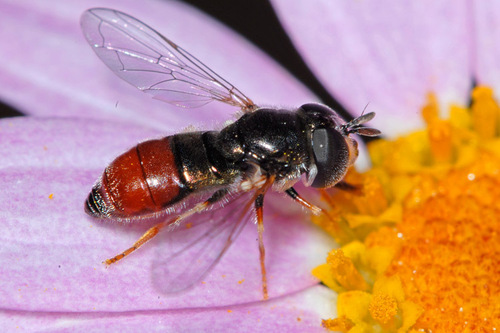
Paragus haemorrhous Meigen, 1822 has an adult body length of 4.3–5.9 mm (0.17–0.23 in). Terminology used follows the Speight key to genera and its associated glossary, with an external link to iNaturalist images provided for reference. The face is yellow, moderately projecting, and marked with a black median stripe in individuals of both sexes. The third antennal joint is sordid reddish on its lower portion, and the eyes are uniformly covered in fine hairs (pilose). The scutellum of the thorax is entirely black. The first abdominal segment is black and well-developed. The second abdominal segment is either entirely black, or has a red posterior margin. In males, abdominal segments 3 through 5 are usually entirely red-orange to dark red. The male superior lobe varies in shape and size; its apex ranges from nearly truncate to strongly oblique, and its length is between one and two times the length of the surstylus. The wings are hyaline, with a brownish grey stigma. The legs are yellow to light brownish yellow; the basal half of the femora is black, and the apical half of the hind tibia is usually yellow-orange. Females of this species cannot be identified from the characters described here; see the cited references for full identification details. This species occurs in multiple biogeographic regions: in the Palearctic it ranges from Fennoscandia south to Iberia, the Mediterranean basin, Israel and Turkey, and from Ireland east through Central Europe, Southern Europe (including Italy and the former Yugoslavia) into European Russia; in the Nearctic it ranges from Yukon south to Costa Rica; and it is also found in parts of the Afrotropical region.