About Paradoxornis heudei David, 1872
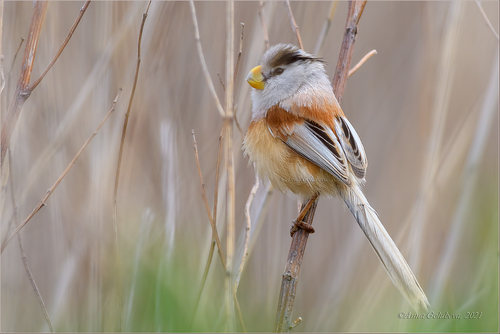
This species, the reed parrotbill (scientific name Paradoxornis heudei David, 1872) from the family Paradoxornithidae, has distinctively short, wide, deep bills. It is the only parrotbill species that changes its appearance between breeding and non-breeding seasons. In the non-breeding winter season, the reed parrotbill has a pinkish-cream and ash-gray forehead and neck. It has black and warm brown streaks running from above the eyes to the tip of the head. The area between its eyes and bill is slightly whiter than its forehead. A white-tinted stripe extends from the base of the beak above the eye, ending towards the back of the head. Its ear color matches the color of its crown, the top of the head. Black and brown streaks cover the body, and these streaks get darker black further down the body. In the breeding summer season, feathers from the top of the head to the upper middle back below the neck feathers are bluish-gray. The lower ends of these feathers are dark chestnut. Ears are slightly paler, and the sides of the body are a lighter chestnut than they are in non-breeding season. Reed parrotbills are native to East Asia. Their natural habitat is the reedbed: a very wet area of reed plants growing between water and land. The species depends on reedbeds, which provide both water and food for the birds. In recent times, the reed parrotbill population has declined because of widespread reedbed degradation. This habitat loss has had a harmful effect on the species' population.