About Paradisaea minor Shaw, 1809
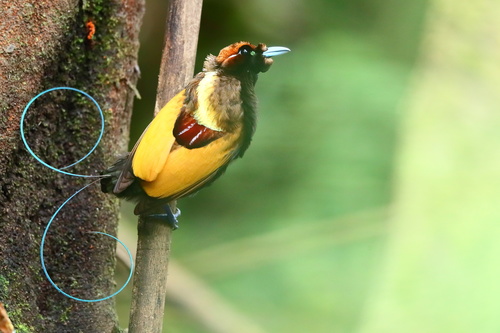
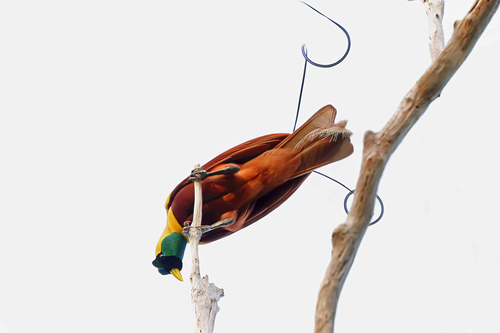
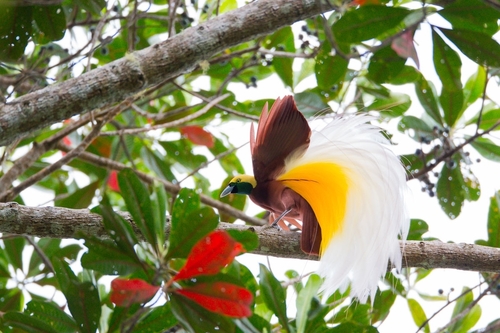
The lesser bird-of-paradise (scientific name Paradisaea minor Shaw, 1809) is a medium-sized bird, reaching up to 32 cm (13 in) in length. Its body is maroon-brown, with a yellow crown and a brownish-yellow upper back. Males have a dark emerald-green throat, a pair of long tail-wires, and ornamental flank plumes that are deep yellow at their base and fade to white toward their outer ends. Females are maroon with a dark-brown head and whitish underparts. While further research is needed, current evidence suggests that birds-of-paradise may have toxins in their skins, which are obtained from the insects they eat. This species resembles the larger greater bird-of-paradise, but the male greater bird-of-paradise has a dark chest, and the female greater bird-of-paradise is entirely brown with no whitish underparts. The lesser bird-of-paradise is distributed across the forests of northern New Guinea, as well as the nearby islands of Misool and Yapen. It is widespread and common throughout its large range, so it is currently classified as Least Concern on the IUCN Red List of Threatened Species. It is also listed on Appendix II of CITES.