About Paracirrhites forsteri (Schneider, 1801)
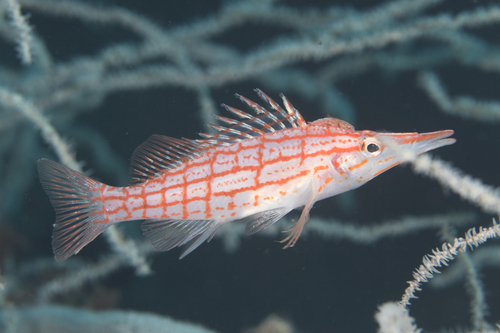
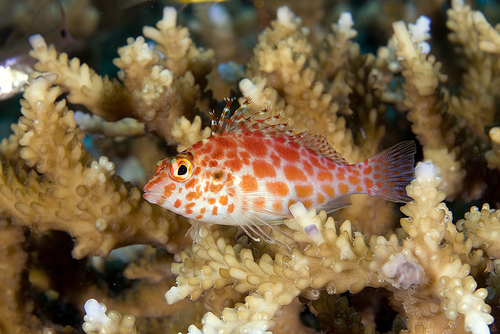
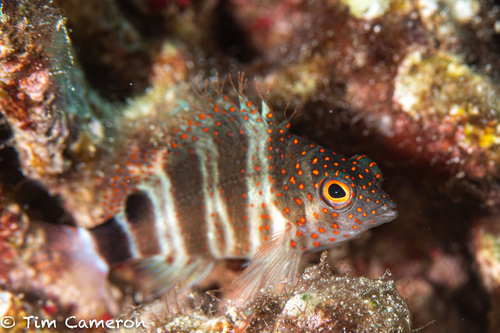
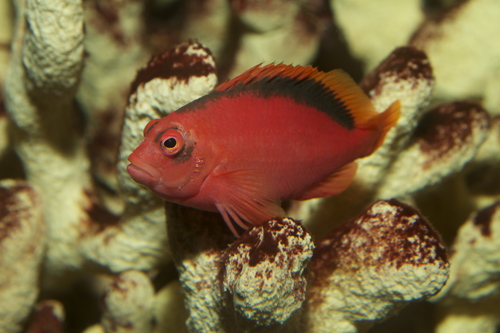
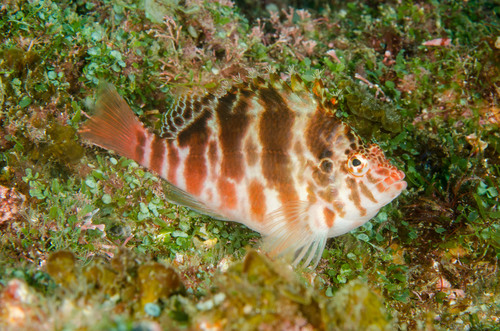
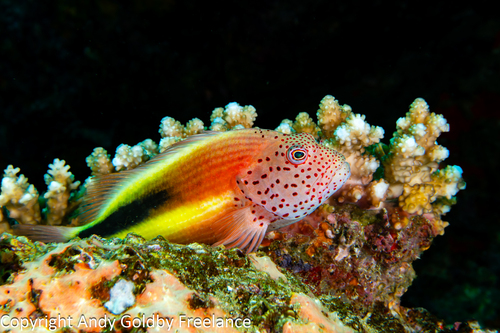
The blackside hawkfish reaches a maximum total length of about 22 centimeters (9 inches). Its dorsal fin has ten spines and eleven soft rays, while its anal fin has three spines and six soft rays. Colouring varies considerably between adults, and also changes as the fish grows. Its main body colour is usually yellowish, with a broad black or dark brown lateral band that occurs mostly on the rear half of the body. The sides of the head and the front of the body are whitish or grey, with red speckles. In Asia, juvenile blackside hawkfish may be reddish on their dorsal side, while juveniles in Oceania typically have golden-green upper parts and white underparts. The blackside hawkfish is native to the tropical and sub-tropical Indo-Pacific Ocean. Its range extends from East Africa and the Red Sea to Japan, New Caledonia and Australasia. In Australia, its range extends from northwestern Western Australia around the northern coast of the country to the border of Queensland and New South Wales. It can be found on the seaward side of reefs and in soft-bottomed lagoons, at depths of 30 meters (100 feet) and greater. The blackside hawkfish is an ambush predator. It usually lies in wait on a coral head, propped up by its stiff pectoral fins, ready to dart out to catch passing crustaceans or small fish. It is mostly solitary, but may be found in pairs, or form small harems consisting of one dominant male and several females. Like other members of its family, it is a sequential hermaphrodite. Adults start life as females, but if the position of male in a group becomes vacant, the largest female in the group changes sex to become a male.