About Paracirrhites arcatus (Cuvier, 1829)
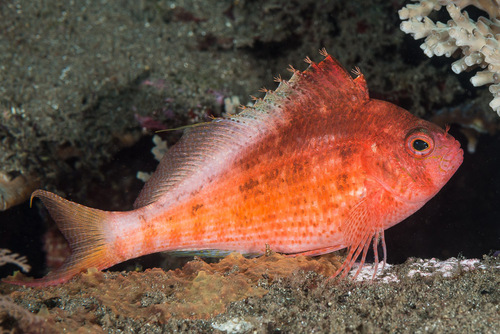
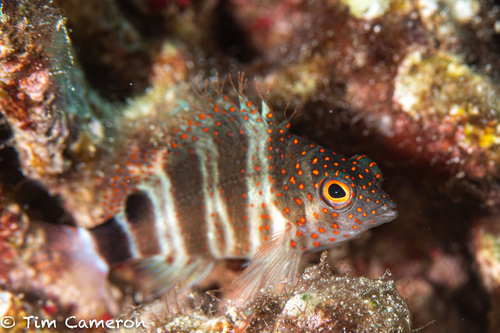
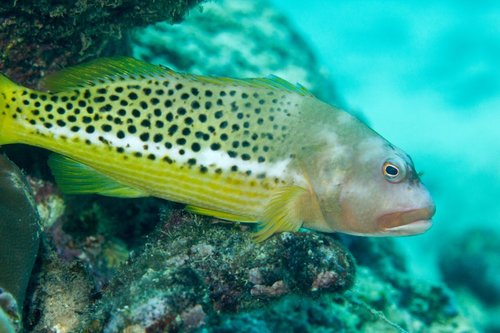
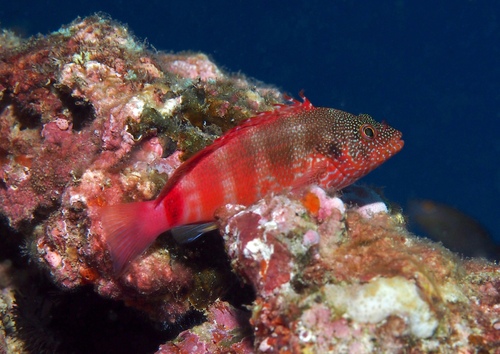
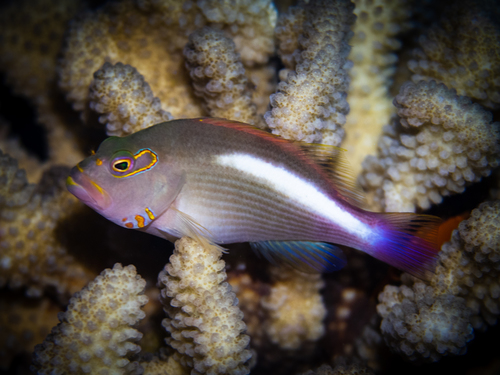
The arc-eye hawkfish, with the scientific name Paracirrhites arcatus (Cuvier, 1829), has a relatively deep body, where its standard length is approximately 2.7 times its body depth. It has a smooth upper preopercular margin, and a caudal fin that ranges from slightly rounded to truncate in shape. Its dorsal fin holds 10 spines and 11 soft rays, while its anal fin has 3 spines and 6 soft rays; every dorsal fin spine is tipped with a branched cirrus. This species reaches a maximum published total length of 20 cm, or 7.9 inches. The background body color of this species is variable, and the most typical color is pale pinkish brown. Behind the eye, there is a horseshoe-shaped mark made up of three thin lines. The gill cover bears three orange bands set within a light blue area, and a white to pink stripe is frequently present, running from around the midpoint of the flank toward the rear of the body. The arc-eye hawkfish is widespread across the tropical Indo-Pacific. Its range stretches from East Africa, from southern Somalia to South Africa, east across the Indian Ocean into the Pacific Ocean, reaching as far east as the Hawaiian Islands and Pitcairn Islands, as far north as Japan, and as far south as Australia. In Australia, it has been recorded from waters off Shark Bay to the Muiron Islands and offshore reefs of Western Australia, at Ashmore Reef in the Timor Sea, and from the northern Great Barrier Reef and reefs in the Coral Sea south to the Solitary Islands in New South Wales. It has also been recorded at Australia's Indian Ocean territories of Christmas Island and the Cocos (Keeling) Islands, as well as at the Tasman Sea locations of Middleton Reef, Elizabeth Reef and Norfolk Island. It is a benthic species that associates with coral reefs, and is most commonly found in lagoon and seaward reefs at depths between 1 and 30 meters, or 3 feet 3 inches to 98 feet 5 inches, with a maximum recorded depth of 91 meters, or 299 feet.