About Parachromis managuensis (Günther, 1867)
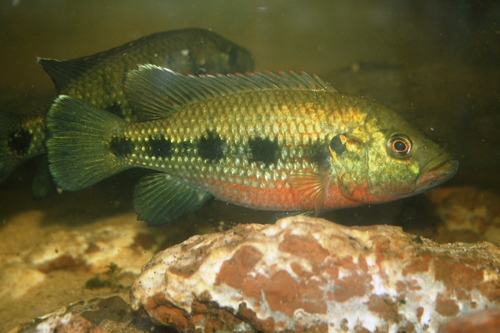
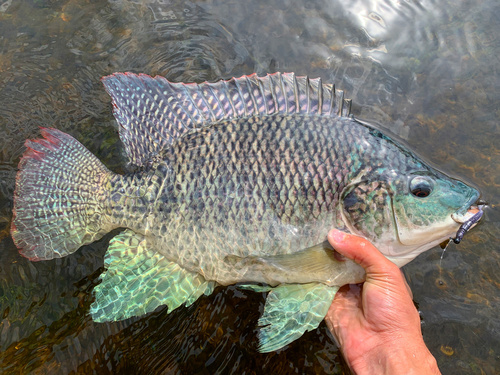
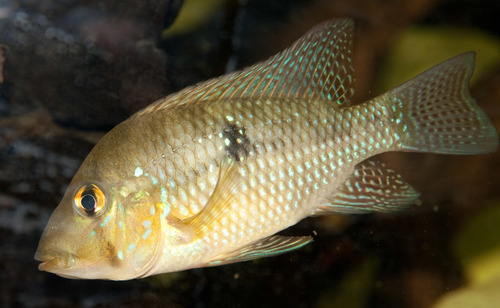
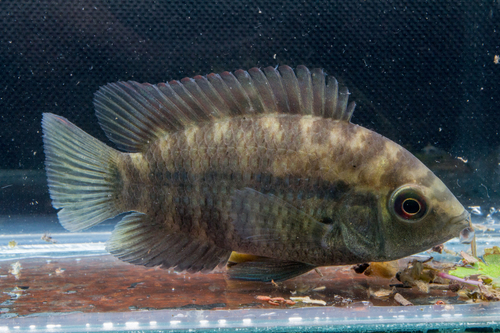
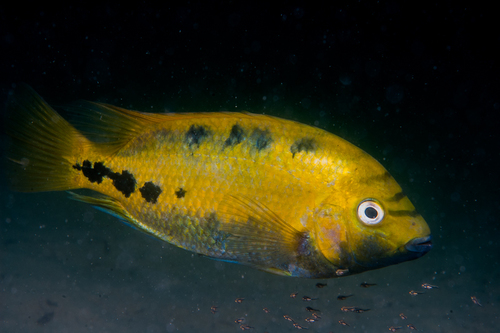
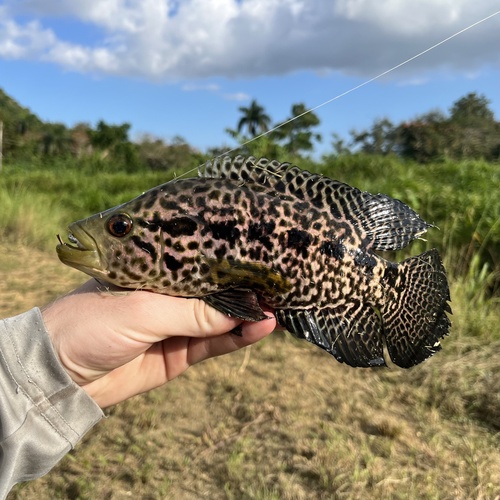
Parachromis managuensis is a robust fish with a base body color ranging from silvery or golden-green to purple, with a darker moss green shade along the dorsum. Its sides display purple iridescence, and its belly is whitish or yellowish. A horizontal series of several large black dots runs along the lateral line area. Its fins are often dark to black in color, particularly when the fish shows spawning coloration. The most distinct feature of this species is a black stripe that runs from the eye to the opercular margin. Males of this species reach a maximum total length of 65 centimetres (26 in), while females grow to 40 centimetres (16 in). Females also lack the elongated extensions on the dorsal fins that males have. The native range of Parachromis managuensis extends from the Ulúa River in Honduras to the Matina River basin in Costa Rica. It has been introduced to other locations in Central America and to the United States, introduced as a food fish, for the aquarium trade, and to control fish populations. Parachromis managuensis lives in lakes, and prefers turbid waters with mud bottoms. It can tolerate both eutrophic and hypoxic water conditions. It is a carnivorous, highly predatory species. Adult individuals feed mainly on small fish, while juveniles feed on a variety of macroinvertebrates. This species is most often found in turbid, eutrophic lakes, and frequently occurs in warm oxygen-depleted water. While its preferred native substrate is mud bottoms, it can also be found in ponds and springs with sandy bottoms covered in plant debris. It occupies lakes in tropical climates, and prefers water with a pH between 7.0 and 8.7, a water hardness between 10 and 15 dGH, and a water temperature between 25 and 36 °C (77 to 97 °F).