About Paracheirodon innesi (Myers, 1936)
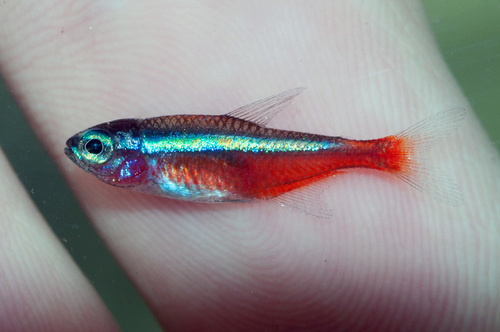
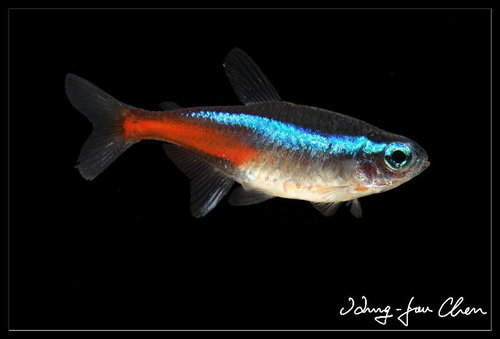
The neon tetra (Paracheirodon innesi) has a light-blue back and a silver-white abdomen. Its defining features are two iridescent horizontal stripes along each side: a bright blue stripe running from the nose to the base of the adipose fin, and an iridescent red stripe that starts at the middle of the body and extends backward to the base of the caudal fin. Apart from these markings, the neon tetra, including its fins, is partially transparent. Sexual dimorphism in this species is slight: females have a slightly larger belly, and their iridescent stripe is bent, while the male's iridescent stripe is straight. When the fish rests at night, its blue and red markings turn gray or black, and they return to their original colors once the fish becomes active again in the morning. This color change happens because neon tetras can alter the color of their iridescent stripes in response to different lighting conditions: when adapted to light, the stripe is blue-green, and when adapted to dark, it changes to indigo. This change is caused by guanine crystals in the fish's cells that reflect light. Neon tetras reach an approximate total length of 4 cm (1.6 in). The natural range of the neon tetra covers the western and northern Amazon basin, specifically in southeastern Colombia, eastern Peru, and western Brazil. It inhabits waters with temperatures between 20 and 28 °C (68–82 °F) and a pH between 4 and 7.5. It prefers acidic blackwater streams, but can also be found in transparent clearwater streams, and does not occur in whitewater rivers. The UN Food and Agriculture Organization lists P. innesi as an introduced species in Singapore and the United States. FAO notes that its introduction to Singapore is ecologically and socioeconomically beneficial, though the species has not become established there.