About Paracheirodon axelrodi (Schultz, 1956)
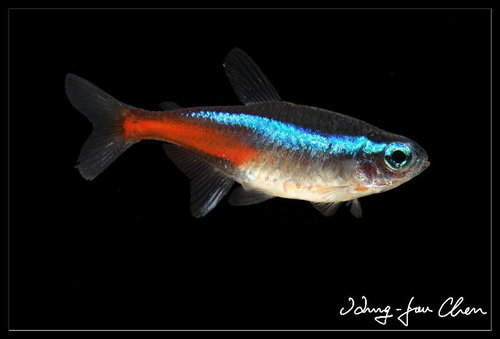
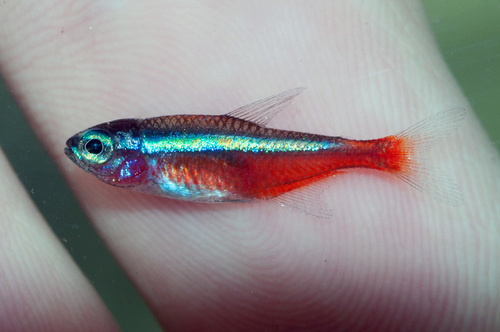
The cardinal tetra (scientific name Paracheirodon axelrodi (Schultz, 1956)) has bright red ventral body parts and a horizontally running iridescent blue line along its body. Like related species including the neon tetra, the characteristic iridescence of this fish is a structural color. It forms from light refracted within guanine crystals that grow inside specialized subcutaneous cells called iridocytes. The exact shade of blue observed depends on the viewer’s angle relative to the fish. If you view the fish from more below, the hue shifts to a deeper sapphire blue, even becoming indigo. If you view the fish from above, the color shifts to a more greenish shade. Cardinal tetras typically grow larger in captivity than they do in the wild, and they have a large stomach and a small gut. This species is distributed in the upper Orinoco river basin across Colombia and Venezuela, and also in the upper Rio Negro of Brazil. In their natural habitat, cardinal tetras swim upstream in large groups to sections of river that are fully covered overhead by rainforest canopy. These areas receive heavy shade from rainforest trees, and almost no sunlight reaches the water there. The fish spawn in large groups in these locations. When fish are ready to spawn, the male chases the female into fine-leaved aquatic plants. At this stage, the female's fuller outline, which indicates she carries ripe eggs in her reproductive tract, is clearly visible. If the female is receptive, she lets the male swim alongside her, and the pair releases eggs and sperm together.