About Paracentrotus lividus (Lamarck, 1816)
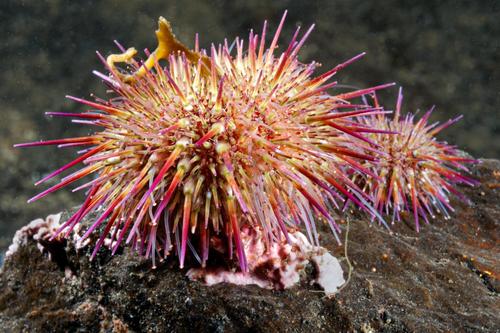
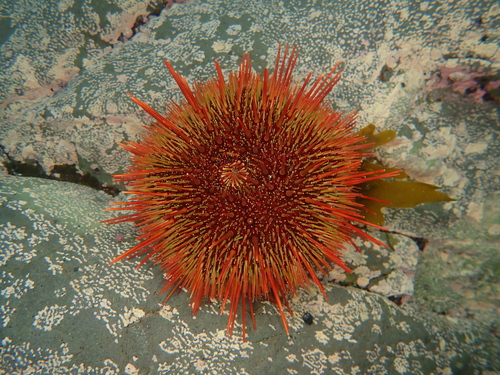
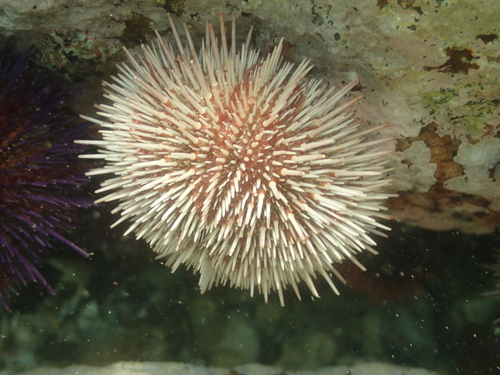
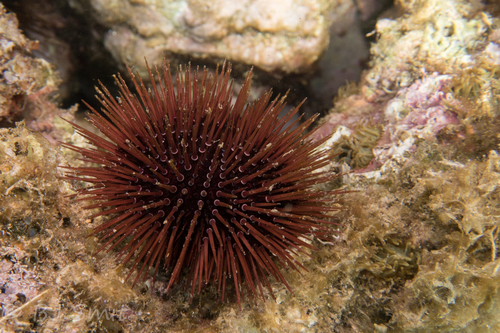
Paracentrotus lividus (Lamarck, 1816) has a circular, flattened greenish test that can reach up to seven centimetres in diameter. The test is densely covered in long, sharply pointed spines, which are usually purple but may occasionally be other colours including dark brown, light brown and olive green. Each ambulacral plate has five or six pairs of pores, and the tube feet are grouped into sets of 5 or 6 arranged in small arcs.
This sea urchin is found throughout the Mediterranean Sea and in the eastern Atlantic Ocean, ranging from western Scotland and Ireland south to the Azores, Canary Islands and Morocco. It is most common in the western Mediterranean, along the coasts of Portugal and in the Bay of Biscay, where winter water temperatures range between 10 and 15 °C.
P. lividus is usually found just below low water mark, at depths down to twenty metres, and sometimes occurs in rock pools. It inhabits rocks, boulders, and seagrass meadows of Zostera marina and Posidonia oceanica. Although Cymodocea nodosa is a preferred food, it is rarely found in meadows of this seagrass, possibly because the shifting sand substrate is not suitable or due to predation pressure. It avoids soft substrates entirely, and can sometimes be found clustered on stones or shell "islands" surrounded by sand. In shallow or exposed waters, it uses its mouth and spines to dig cavities into soft rock that it fits into exactly and returns to repeatedly. Where urchins are abundant, these excavations can honeycomb the rock surface. Smaller individuals particularly use these retreats, which provide protection from predators. In lagoons and rock pools, individual urchins grow smaller than they do in the open sea. P. lividus cannot tolerate low salinity; after extremely heavy rainfall in Corsica in autumn 1993, mass mortality of urchins occurred in the Urbini Lagoon. However, this urchin is relatively unaffected by organic pollution and heavy metals, and even flourishes near sewage outlets. Population densities of P. lividus vary widely across its range, and this variation has not been fully explained.
Paracentrotus lividus is a generalist browser that feeds on a range of red, green, and brown algae, as well as seagrass. The composition of the benthic community is strongly affected by the population size and food preferences of this urchin. Where urchins are abundant, the surrounding area tends to become "barren ground" colonized by encrusting Corallinaceae, with low primary producer biomass and few associated species. Where urchin numbers are low, kelp forests of Laminaria and Cystoseira develop, supporting a much richer, three-dimensional community. These barren grounds can persist for years, but it remains unclear whether this is caused by overgrazing by urchins, or by encrusting algae preventing the recruitment of multicellular photosynthetic organisms. Juveniles of several small fish species take shelter among the spines of P. lividus, including the clingfishes Apletodon incognitus and Lepadogaster candolii, and the gobies Gobius bucchichi, Zebrus zebrus and Millerigobius macrocephalus.
The main predators of P. lividus in the Mediterranean Sea are the spider crab Maja crispata, the fish Diplodus sargus, Diplodus vulgaris, Labrus merula and Coris julis, and the gastropod Hexaplex trunculus. Elsewhere, the main predator is the spiny starfish Marthasterias glacialis. Vulnerability to predation depends on urchin size; juvenile urchins are more vulnerable because their spines are less formidable. In most locations, these urchins feed at night, but in areas where predators are more active at night, P. lividus may shift to feeding during the day.
The gonads of P. lividus are considered a delicacy in Lebanon, France, Italy, Spain, Malta, and parts of Croatia, most notably on the island of Korčula. They are also eaten to a lesser degree in Greece and Tunisia. Urchins are harvested for export across a wider area that includes Croatia, Portugal and Ireland. Sea urchin gonads have been popularized in modern cuisine as "Uni", and Paracentrotus lividus is known as "Murasaki Uni". It is primarily harvested in Hokkaido, Japan alongside the related "Bafun Uni".