About Paracentropyge multifasciata (Smith & Radcliffe, 1911)
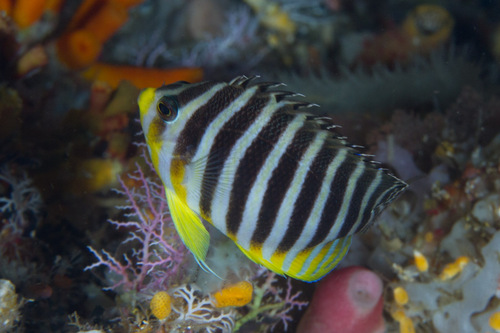
Paracentropyge multifasciata, also known by its scientific name Paracentropyge multifasciata (Smith & Radcliffe, 1911), has a white body base color marked with 8 black vertical bars. These bars turn yellowish as they approach the ventral part of the body. There is a distinct black spot on the posterior portion of the dorsal fin, which fades as the fish grows older. The mouth, pelvic fins, and anal fin are all yellow. Each spine on the dorsal fin ends in a single thin thread, while the pelvic fin tips have one pair of these threads each. The caudal fin is hyaline and marked with a row of black spots. Juveniles of this species have less distinct bands. The dorsal fin holds 13 spines and 17 to 19 soft rays, and the anal fin holds 3 spines and 17 to 18 soft rays. This species reaches a maximum total length of 12 centimetres, which equals 4.7 inches.
This species is distributed across the Indo-Pacific region. Its range extends from the Cocos (Keeling) Islands, an Australian territory, in the west, eastwards to the Society Islands in French Polynesia. Its distribution extends north to Japan's southern Ryukyu Islands and south to Queensland's Great Barrier Reef.
Paracentropyge multifasciata occurs at depths between 7 and 70 metres, or 23 and 230 feet. It lives under overhangs, and inside caves and crevices on the steep outer slopes of reefs, and it is sometimes also found in reefs located in the clear waters of lagoons. It is a cryptic species that rarely travels more than a short distance away from its hiding place. Individuals are typically found in pairs or small groups. It is believed to feed on algae, sponges, tunicates, and a variety of crustaceans. This species lives in harems, made up of one dominant male and usually multiple females. Like all other angelfish, it is a protogynous hermaphrodite: all individuals start life as female, and dominant individuals later change sex to male. It is a broadcast spawner, releasing eggs and sperm into the water after a long mating ritual. The eggs are 0.7mm in diameter, and they hatch after 16 to 18 hours. The larvae have a pelagic phase that lasts up to 50 days, after which they settle into a benthic phase and begin metamorphosis into juveniles.