About Paracanthurus hepatus (Linnaeus, 1766)
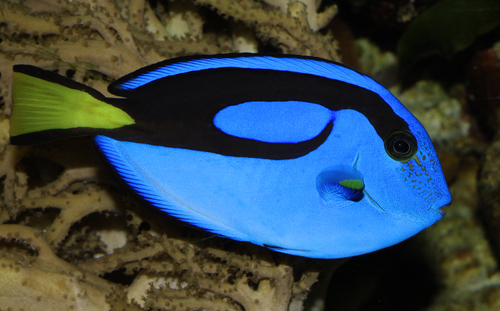
Paracanthurus hepatus (Linnaeus, 1766), commonly called the regal blue tang, has a distinctive appearance: a royal blue body, bright yellow tail, and a black palette-shaped marking. It reaches 149.2 mm in length at first sexual maturity; adult individuals typically weigh around 600 g (21 oz), and males are generally larger than females. A broad black area along its back encloses the tip of the pectoral fin, forming a blue oval on each side of the fish that extends toward the eye. The tail features a bright yellow triangle, with its apex positioned anterior to the caudal spine and its base at the posterior end of the caudal fin. This yellow triangle is surrounded by black on the upper and lower lobes of the caudal fin, matching the black color of the area on the back. The species has small scales, each with short ctenii on the upper surface. Scales located on the caudal spine have ctenii approximately three times as long as those on scales from the rest of the body. Scales positioned on the anterior head, between the eye and upper jaw, are larger and bear tuberculated bony plates. This fish has a compressed, elliptical body shape and a terminal snout. It has nine dorsal spines, 26–28 dorsal soft rays, three anal spines, 24–26 yellow anal soft rays, and 16 principal caudal rays, with slightly projecting upper and lower lobes. Its pelvic fin consists of one spine and three rays; this trait is recognized as a synapomorphy shared by the genera Naso and Paracanthurus. A caudal spine sits in a shallow groove on the caudal peduncle, which is also a characteristic of its sister taxon Zebrasoma. This species has 22 vertebrae. Its teeth are small, close-set, denticulated, and described as incisor-like. In jaw morphology, the ectopterygoid connects the palatine to the quadrate near the articular condyle. A crest is present on the anterodorsal surface of the hyomandibular. The opercle is less developed and has a distinctly convex profile. Slight appearance variation occurs across populations: individuals from the west-central Indian Ocean have yellow lower bodies, while individuals from the Pacific have bluish lower bodies. The blue pigment on the trunk can lose pigmentation in response to changes in light or melatonin levels, making the fish appear lighter in color at night. The regal blue tang is found across the Indo-Pacific, inhabiting reefs in the Philippines, Indonesia, Japan, the Great Barrier Reef of Australia, New Caledonia, Samoa, East Africa, and Sri Lanka. One single specimen was photographed in 2015 in the Mediterranean Sea off the coast of Israel. Vagrants have been recorded on two separate occasions in Hawaii, and these individuals are assumed to be released aquarium fish. It is an established extant resident in: American Samoa; Australia; British Indian Ocean Territory; Brunei Darussalam; Christmas Island; Cocos (Keeling) Islands; Comoros; Cook Islands; Disputed Territory (Paracel Is., Spratly Is.); Fiji; French Southern Territories (Mozambique Channel Is.); Guam; India (Nicobar Is., Andaman Is.); Indonesia; Japan; Kenya; Kiribati (Kiribati Line Is., Phoenix Is., Gilbert Is.); Madagascar; Malaysia; Maldives; Marshall Islands; Mauritius; Mayotte; Federated States of Micronesia; Myanmar; Nauru; New Caledonia; Niue; Northern Mariana Islands; Palau; Papua New Guinea; Philippines; Réunion; Samoa; Seychelles; Singapore; Solomon Islands; Somalia; South Africa; Sri Lanka; Taiwan, Province of China; United Republic of Tanzania; Thailand; Timor-Leste; Tokelau; Tonga; Tuvalu; United States (Hawaiian Is.); United States Minor Outlying Islands (US Line Is., Howland-Baker Is.); Vanuatu; Viet Nam; Wallis and Futuna. Paracanthurus hepatus is a diurnal marine species that lives in marine neritic coastal habitats. It occurs in clear water on exposed outer reef areas or in channels with moderate to strong current. It primarily occupies coral reef habitats, but also lives in seagrass beds, mangroves, algal beds, and rocky reefs. It is found at depths ranging from 2 meters to 40 meters. Adults live in pairs or small groups of 8 to 14 individuals, and are often found near cauliflower corals on the seaweed side of coral reefs. Juveniles school among Acropora corals for shelter. The population sex ratio of males to females is typically 1:1. This species supports coral health by feeding on algae that would otherwise overgrow and choke corals. Spawning occurs year-round, with a peak between April and September. It takes place during late afternoon and evening on outer reef slopes. Spawning is marked by a color change from uniform dark blue to pale blue. Males aggressively court females in the school, triggering a quick upward spawning rush toward the water surface during which eggs and sperm are released. The eggs are small, approximately 0.8 millimetres (1⁄32 in) in diameter, and are pelagic; each egg contains a single oil droplet to aid flotation. Fertilized eggs hatch within 24 hours, producing small, translucent larvae with silvery abdomens and rudimentary caudal spines. Once the juvenile body becomes opaque, the black palette pattern does not fully connect until the fish reaches maturity. This species reaches sexual maturity at 9–12 months of age, at approximately 149.22 mm in total length. Fecundity has a positive correlation with body weight. Like other members of the family Acanthuridae, Paracanthurus hepatus produces altricial larvae that receive no parental care. After hatching, larvae rely on yolk reserves to survive for their first two to three days of life.