About Paracaesio xanthura (Bleeker, 1869)
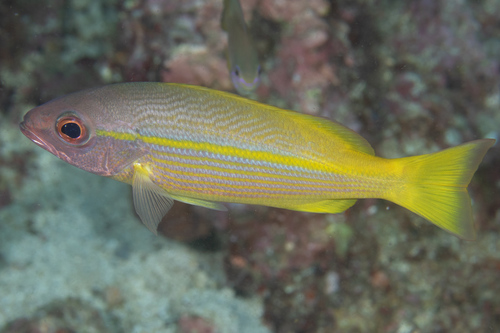
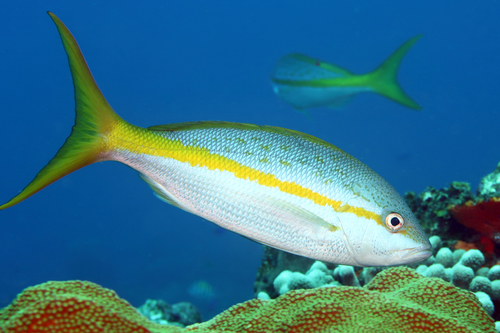
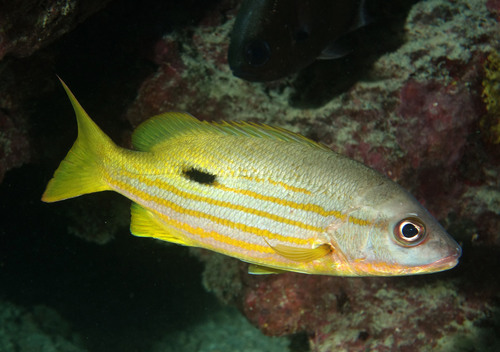
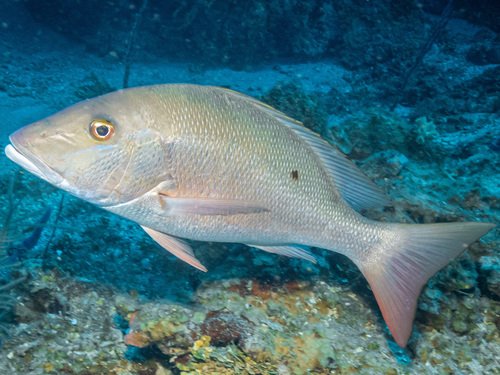
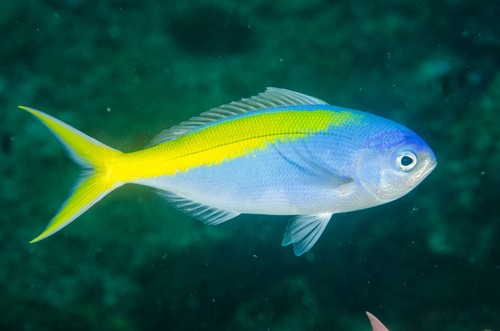
Paracaesio xanthura (Bleeker, 1869) has a fusiform, moderately deep body. It has large eyes separated by a convex area, and a short snout that is the same length as the eye diameter. Its upper and lower jaws are roughly equal in length; the jaws have an outer row of canine-like teeth and an inner band of small bristle-like teeth. The dorsal fin of this species has 10 spines and 10 to 11 soft rays, while the anal fin has 3 spines and 8 to 9 soft rays. Paracaesio xanthura reaches a maximum total length of 50 cm (20 in). This species is bright blue, with a vivid yellow band that runs along its back and extends onto the caudal peduncle and caudal fin. This species has a wide distribution across the Indo-Pacific region. It occurs along the eastern African coast from Kenya to South Africa, through the Indian Ocean, including Madagascar, the Comoros Islands, Seychelles, Mauritius, Réunion, the Gulf of Aden, the Maldives, Chagos Islands, Sri Lanka, and southern India. In the Pacific Ocean, it ranges as far north as southern Japan, as far south as Australia, and extends from the Andaman Sea in the west east to the Austral Islands. In Australia, it can be found at Houtman Abrolhos, on offshore reefs off northwestern Western Australia, on the northern Great Barrier Reef in Queensland, south to Montague Island in New South Wales, and east to Lord Howe Island in the Tasman Sea. Paracaesio xanthura is associated with reefs and occurs over rocky substrates, where it occasionally forms large aggregations. It feeds mainly on zooplankton, and is found at depths between 5 and 250 m (16 and 820 ft).