About Parablennius gattorugine (Linnaeus, 1758)
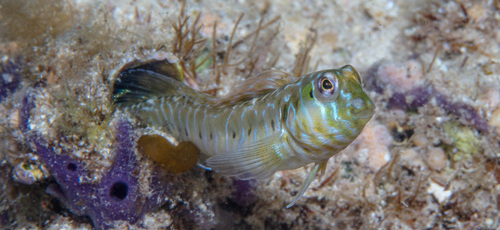
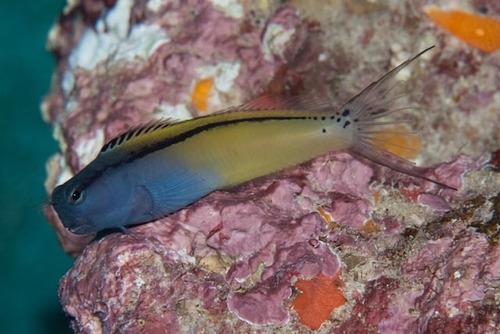
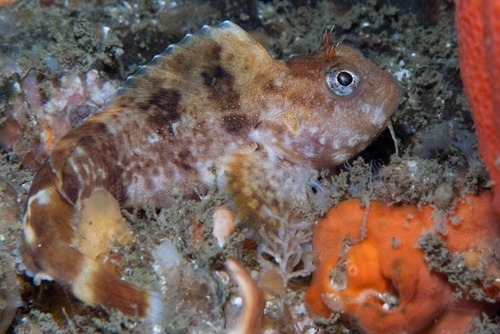
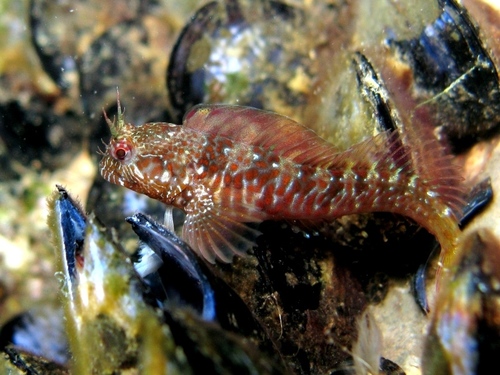
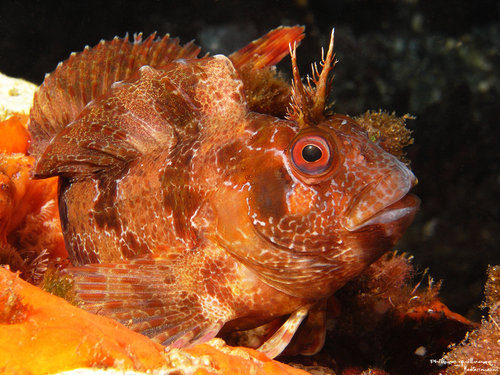
Parablennius gattorugine, commonly known as the tompot blenny, is a relatively large blenny species with an elongated body, large head, and large eyes. It reaches a maximum length of 30 centimetres (12 in). Each eye is bicoloured, with a brown upper half and a white lower half, and a single branched tentacle sits above each eye. Additional tentacles are also present above the nostrils. The species is mainly yellow-brown in colour, though occasional individuals are greenish; all individuals are marked with at least seven dark bars that start at the dorsal fin and extend down to the belly. The lateral line is continuous along most of the body, but becomes broken toward the tail. The dorsal fin runs the entire length of the body, and is split into two halves by a shallow notch: the anterior portion holds spiny rays, while the posterior portion holds soft rays. The dorsal fin has 13–14 spines and 17–20 soft rays, and the anal fin has 2 spines and 19–23 soft rays. The pectoral fins are relatively large. During the breeding season, males turn chocolate brown and develop bulb-like glands on the spines of the anal fin. Each individual tompot blenny has a unique set of markings on the scales of its face, which allows researchers to identify individual fish for biological studies. The tompot blenny is found along the Atlantic coast of Europe, ranging from southern England and Ireland south to Morocco. It also occurs throughout the Mediterranean Sea, extending to the Sea of Marmara and the Black Sea. Within Great Britain, it is recorded mainly off the south and west coasts, and is largely absent from North Sea coasts. It has however been recorded on wrecks off the North Norfolk coast, and off eastern Scotland as far north as the Shetland Islands. Tompot blennies are highly territorial, with territories centered around a rocky crevice the fish uses for shelter. They inhabit shallow seas at depths of 3–32 metres (9.8–105.0 ft), while smaller specimens are often found in rockpools. At very low tides, they may occur above the low tide mark, sheltering under boulders or among exposed vegetation.