About Papio ursinus (Kerr, 1792)
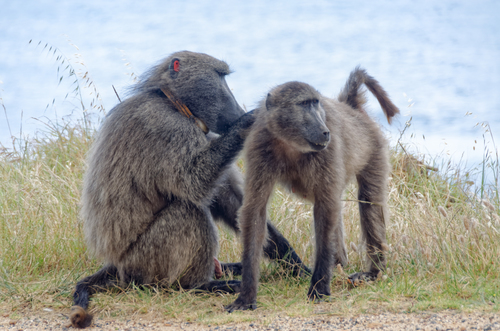
The chacma baboon, scientifically named Papio ursinus (Kerr, 1792), is possibly the longest extant monkey species. Adult body length ranges from 50 to 115 cm (20 to 45 in), while tail length measures 45 to 84 cm (18 to 33 in). It is also one of the heaviest monkey species, displaying strong sexual dimorphism: females are considerably smaller than males. Adult males weigh between 21 and 45 kg (46 to 99 lb), with an average weight of 31.8 kg (70 lb); adult females weigh between 12 and 25 kg (26 to 55 lb), with an average weight of 15.4 kg (34 lb). In some cases, adult males can be roughly twice as long and three times as heavy as adult females. The chacma baboon is similar in size to the olive baboon, with a slightly higher average mean body mass. It has a similar weight to the more compact mandrill: male mandrills average about 1 kg (2.2 lb) heavier than male chacma baboons, while female mandrills are 3 kg (6.6 lb) lighter than female chacma baboons. Though mandrills are typically recognized as the largest living monkeys, when measured by total length and average (not maximum) body mass across both sexes, the chacma baboon is considered the largest extant monkey. The chacma baboon’s fur is generally dark brown to gray, with a patch of coarse hair on the nape of its neck. Unlike males of northern baboon species (Guinea, hamadryas, and olive baboons), male chacma baboons do not have a mane. The species’ most distinctive feature is its long, downward-sloping face. When male chacma baboons leave their natal troop, their canine teeth have an average length of 3.86 ± 0.30 cm (1.52 ± 0.12 in). This is the maximum tooth length they reach, as teeth become worn or broken over time. The species has three subspecies, distinguished by differences in size and color. The Cape chacma is large and heavy, with dark brown fur and black feet. The gray-footed chacma is slightly smaller than the Cape chacma, with lighter fur, a slighter build, and gray feet. The Ruacana chacma is generally a smaller, less darkly colored version of the Cape chacma. Chacma baboons live across a wide variety of habitats, including woodland, savanna, steppes, and subdesert, ranging from the grassy alpine slopes of the Drakensberg to the Kalahari Desert. At night, they sleep on top of steep hills, high cliffs, rocks, or in large trees, to stay away from nocturnal predators. During the day, access to water can limit the species’ range in arid regions. The chacma baboon is found across southern Africa, ranging from South Africa northward to Angola, Zambia, and Mozambique. Its subspecies are distributed across separate parts of this range: the Cape chacma lives in southern South Africa; the gray-footed chacma occurs from northern South Africa, through Botswana’s Okavango Delta, Zimbabwe, Mozambique (south of the Zambezi), to southwest Zambia; and the Ruacana chacma inhabits northern Namibia and southern Angola.