About Papio hamadryas (Linnaeus, 1758)
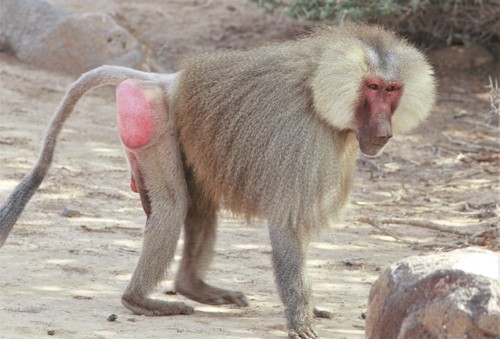
Adult Papio hamadryas, commonly known as the hamadryas baboon, have distinct coloration that differs by sex. Males develop a prominent silver-white mane and mantle around 10 years of age, while females lack this cape, are entirely brown, and have faces ranging from reddish to dark brown. This species also shows sexual dimorphism in size, with males reaching nearly twice the size of females. Males can grow up to 80 cm (31 in) in body length and weigh 20–30 kg (44–66 lb), while females measure 40–45 cm (16–18 in) in body length and weigh 10–15 kg (22–33 lb). The baboon's tail adds an extra 40–60 cm (16–24 in) to total length and ends in a small tuft. Newborn infants are colored very dark brown or black, and their coat lightens after approximately one year. Females reach sexual maturity around four years old, while males reach maturity between five and seven years old. The hamadryas baboon's native range stretches from the Red Sea coast of Eritrea through Ethiopia, Djibouti, and Somalia, and it is also native to the Sarawat Mountains of southwestern Arabia, found in both Yemen and Saudi Arabia. It is considered locally extinct in Egypt. This species inhabits arid regions, savannas, and rocky areas, and requires cliffs for sleeping and access to water. Like all baboons, it is omnivorous and well adapted to its relatively dry habitat. During wet seasons, it feeds on a wide variety of plant foods including acacia tree blossoms, fruits, seeds, grasses, rhizomes, corms, wild roots, tubers, bark, tree gums, and leaves. During dry seasons, hamadryas baboons eat leaves of Dobera glabra and sisal leaves. Their diet also includes animal matter: eggs, insects, spiders, worms, scorpions, reptiles, birds, and small mammals including antelope. The baboon's access to drinking water changes with the seasons. During wet seasons, water pools are easily available close to their ranges. During dry seasons, the baboons regularly visit up to three permanent waterholes. They rest at these waterholes during midafternoon, and will also dig their own drinking holes a short distance from the natural waterholes. Like other baboons, hamadryas baboons breed year-round with no set breeding season. Most mating is done by the dominant male of a one-male social unit, though other males may occasionally sneak opportunistic copulations. Females handle the majority of infant care: they nurse and groom their young, and a female in a unit may even groom an infant that is not her own. Like all baboons, hamadryas baboons are highly interested in infants and give them a great deal of attention. Dominant males prevent other males from getting close to their infants, protect the young from predators, tolerate the young in their unit, and will carry and play with infants. When a new male takes over a unit from a previous dominant male, the female develops sexual swellings; this may be an adaptation to stop the new male from killing the previous male's offspring. When males reach puberty, they develop a playful interest in young infants. Known more commonly among "follower" males, this behavior involves luring infants away from their original harems and inviting them to ride on the males' backs in a form of kidnapping. This kidnapping can leave infants dehydrated or starved, and the harem leader will retrieve stolen infants to protect his offspring.