About Papio anubis (Lesson, 1827)
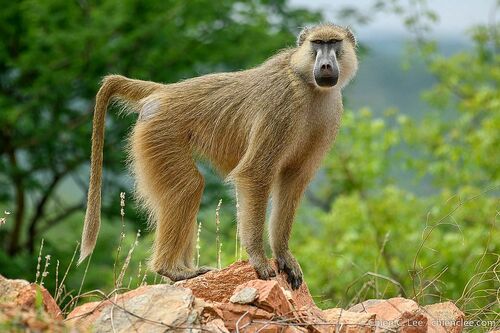
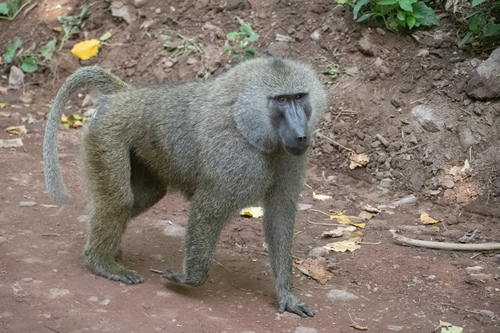
The olive baboon (scientific name Papio anubis) gets its common name from the green-grey shade of its coat when viewed from a distance. When seen up close, its coat is multicoloured, because individual hairs have alternating rings of yellow-brown and black. The hair on its face is coarser, and ranges in colour from dark grey to black. Both sexes share this same general colouration, though males have a mane of longer hair that tapers to the ordinary hair length along the back. Beyond the mane, males and females differ in weight, overall body size, and canine tooth size. On average, standing males are 70 cm (28 in) tall, while standing females measure 60 cm (24 in) in height. The olive baboon is one of the largest species of monkey, alongside chacma baboons, mandrills, and muriquis. Its head-and-body length ranges from 50 to 114 cm (20 to 45 in), with a species average of around 85 cm (33 in). When on all fours, average shoulder height is 55 cm (22 in) for females and 70 cm (28 in) for males. The reported typical weight range for both sexes combined is 10–37 kg (22–82 lb), with males averaging 24 kg (53 lb) and females averaging 14.7 kg (32 lb). Some males may weigh as much as 50 kg (110 lb). Like other baboons, the olive baboon has an elongated, dog-like muzzle. Its 38 to 58 cm (15 to 23 in) long tail and four-legged gait can make it appear similar to a canine. The tail has an unusual shape that looks almost broken: it stays erect for the first quarter of its length, then drops off sharply. The bare skin patch on an olive baboon's rump is smaller than the equivalent patch found on Hamadryas baboons or Guinea baboons. Like most cercopithecines, the olive baboon has a cheek pouch it uses to store food. This species lives across 25 equatorial African countries in a continuous strip that stretches almost from the continent's east coast to its west coast. The exact boundaries of this range are not clearly defined, because the olive baboon's territory overlaps with the ranges of other baboon species. In many overlapping areas, this overlap leads to cross-breeding between species. For example, considerable hybridisation has occurred between olive baboons and hamadryas baboons in Ethiopia. Cross-breeding with yellow baboons and Guinea baboons has also been observed. While this hybridisation has been documented, the hybrids themselves have not yet been thoroughly studied. Across its wide range, the olive baboon lives in many different habitats. It is most often classified as savannah-dwelling, and lives across the wide plains of African grasslands. Grasslands, especially those near open woodland, do make up a large part of its habitat, but the species also lives in rainforests and deserts. For example, Uganda and the Democratic Republic of the Congo both host olive baboon populations in dense tropical forests. Females reach sexual maturity at seven to eight years old, while males reach sexual maturity between seven and 10 years old. The start of a female's ovulation signals to males that she is ready to mate. During ovulation, the skin of the female's anogenital area swells and turns bright red or pink. This swelling makes moving difficult, and increases the female's risk of microbial or parasitic infection. Females with more swollen anogenital areas begin reproducing at a younger age, produce more offspring per year, and their offspring have higher survival rates. These females also attract more males, and are more likely to trigger aggressive fights between competing males. Olive baboons generally mate promiscuously. A male will form a mating consortship with an estrous female, staying close to her and copulating with her. Males guard their partner to prevent other males from mating with her. Unless a female is in a multi-day consortship, she often copulates with more than one male per day. Multiple copulations are not required for reproduction, but they may make the actual paternity of a female's offspring ambiguous. This uncertain paternity could help reduce the frequency of infanticide. Occasionally, a male olive baboon will monopolize access to a female for her entire period of probable conception, and will protect her from mating with other males during this consortship. Newborns have black natal coats and bright pink skin. Females are the primary caregivers for infants, but males also participate in care. In its first few days of life, an infant may be unable to stay attached to its mother and relies on her for physical support. Its grip grows stronger by the first week, and by that point it can cling to its mother's fur on its own. By two weeks old, the infant begins to explore its surroundings for short periods, while still staying close to its mother. As infants get older, the distance they spend away from their mother increases. In general, higher-ranking females tend to be more relaxed parents than lower-ranking females, who usually keep their offspring close to them. This difference in parenting behaviour lasts for approximately the first eight weeks of an infant's life. Olive baboons do not appear to practice cooperative parenting, though a female may groom an infant that is not her own. Subadult and juvenile females are more likely to care for another female's young, as they have not yet produced offspring of their own. One theory for why immature females seek out infants is that this behaviour helps them prepare for their future roles as mothers. Infant baboons born to first-time mothers have higher mortality than infants born to experienced mothers, which suggests that prior experience caring for infants is important. Adult males in social groups also care for infants, since they are likely related to the infants in their group. Males groom infants to reduce parasite loads, and calm infants when they are stressed. They may also protect infants from predators such as chimpanzees. However, adult males also exploit infants, and often use them as shields to lower the chance that other males will threaten them.