About Papilio zelicaon Lucas, 1852
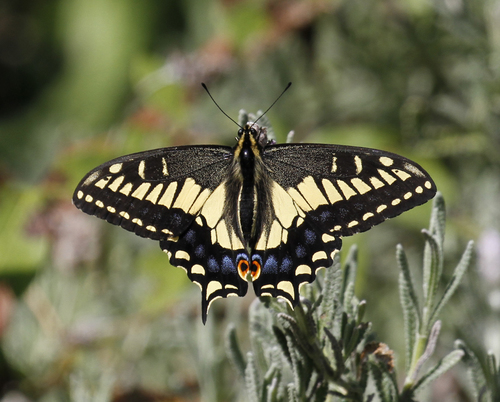
Papilio zelicaon, commonly known as the anise swallowtail, has a wingspan between 52 and 80 mm (2.0 to 3.1 inches). Its wings are mostly yellow, with black bands along the edges of both the forewings and hindwings. It can be distinguished from tiger swallowtail butterflies by its smaller size and lack of vertical black wing striping. Near the tail of each wing, it has yellowish-orange to red eyespots, each with a black center pupil. Its body is mostly black, with yellow stripes running along the sides of the abdomen. The anise swallowtail lives in fairly open habitats, and is most often spotted on bare hills or mountains, in fields, or along roadsides. It is also commonly seen in towns, in gardens or vacant lots. Its normal range reaches from British Columbia and North Dakota at its northern limit, south to the Baja California Peninsula and other parts of Mexico. It is occasionally reported from the southeastern United States, but its regular range does not extend east of New Mexico. In the more northern parts of its range, the chrysalis of this butterfly hibernates. Adult females lay eggs one at a time on the undersides of host plant leaves. In its first two larval instars, the caterpillar is dark brown, almost black, with an irregular white band across its midsection. After these first two instars, the caterpillar becomes more green with each successive molt. By its fifth and final instar, it is predominantly green, with black, orange, and light blue markings. Its main host food plants belong to the carrot family, Apiaceae, including fennel, and also some species from the citrus family, Rutaceae. Like all swallowtail caterpillars, anise swallowtail caterpillars will suddenly evert bright orange glandular structures called osmeteria, or "stinkhorns", from just behind their head when disturbed; these structures release a foul odor. The caterpillar grows to around 5 cm in length before forming a chrysalis, which is either brown or green and measures about 3 cm long. The anise swallowtail pupa resembles a thick branch growing from the larval host plant. The top of the pupa extends slightly away from the plant, held in place by strong silk, and this is where the adult butterfly eventually emerges.