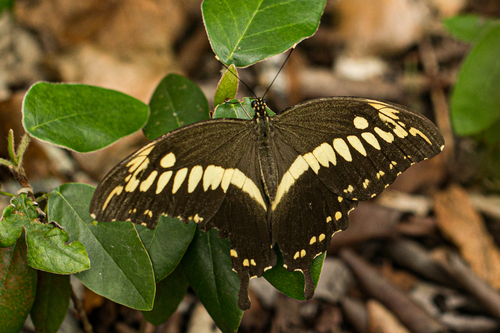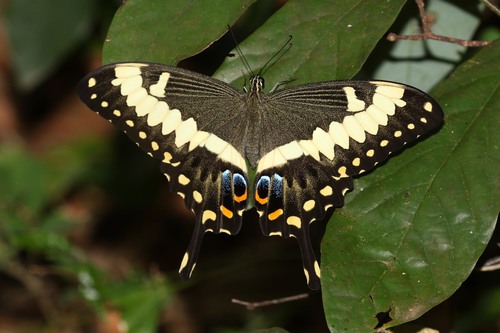
About Papilio troilus Linnaeus, 1758
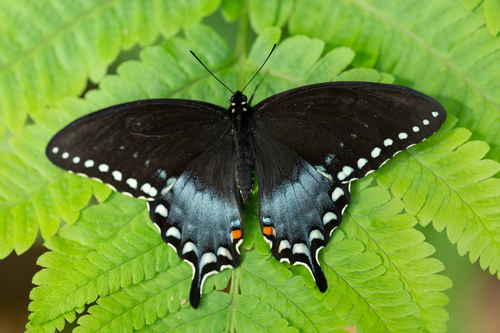
Papilio troilus, commonly known as the spicebush swallowtail or green-clouded butterfly, is a common black swallowtail butterfly native to North America. It has two recognized subspecies: Papilio troilus troilus and Papilio troilus ilioneus. The subspecies P. t. ilioneus is found mainly on the Florida peninsula. This butterfly gets its common name from its most common host plant, spicebush, which belongs to the genus Lindera. Spicebush swallowtails are members of the Papilionidae family, also called swallowtails, a group that includes the largest butterflies in the world. Swallowtail butterflies are unique because they continue fluttering their wings even while feeding. Unlike other swallowtail butterflies, spicebush swallowtails fly low to the ground rather than at great heights. The spicebush swallowtail is normally found only in the eastern United States and southern Ontario, though it occasionally strays as far as the American plains states, Cuba, Manitoba, and Colorado. As larvae, spicebush swallowtails stay on the leaf of the plant where their egg was laid. Adult butterflies do not restrict their flight within narrow geographic boundaries; their movement is driven mostly by the availability of water, nectar, and mates within the species' overall range. This mostly black swallowtail is typically found in deciduous woods or woody swamps, where it flies low and fast through shaded areas. Females tend to remain in open plains, while males are most often found in swamp areas. The most common host plants for spicebush swallowtail caterpillars are spicebush (Lindera benzoin) and white sassafras (Sassafras albidum). Other possible host plants include prickly ash (Zanthoxylum), tulip tree (Liriodendron tulipifera), sweetbay (Magnolia virginiana), camphor (Cinnamomum camphora), and redbay (Persea borbonia). Redbay and swampbay (Persea palustris) are the primary host plants for the P. t. ilioneus subspecies, while spicebush and sassafras are the primary hosts for P. t. troilus. When given a choice between spicebush and sassafras, P. t. troilus shows no significant preference for either. P. t. ilioneus only lives on redbay, as this is the primary host plant within its southern range. In an experiment testing both subspecies on redbay, sassafras, and spicebush, P. t. ilioneus had higher growth and survival rates on redbay than P. t. troilus did. Overall, both subspecies performed better over time when raised on sassafras or spicebush. In general, spicebush swallowtails stick to host plants in the family Lauraceae. This preference for Lauraceae is so consistent that under experimental conditions, when placed in an environment with only non-Lauraceae leaves, P. troilus dies without eating anything. This is notable because Lauraceae are distantly related to the host plants used by other Papilio caterpillar species. It is also notable because most other swallowtail butterfly species are far less host-specific. The selective host plant behavior of P. troilus may be explained by its requirement for positive stimuli to confirm a plant is a Lauraceae before it will feed; for example, Papilio glaucus will immediately attempt to feed on any plant it is presented with. Feeding primarily on Lauraceae has advantages for spicebush swallowtails. For example, they can feed two to four times more adeptly and efficiently on Lauraceae than P. glaucus, which feeds on both Lauraceae and other plant types. No other Lepidoptera species feeds as efficiently on spicebush as P. troilus does. None of P. troilus's host plants grow across the entire range of the spicebush swallowtail. As noted earlier, the Florida subspecies P. t. ilioneus mostly feeds on redbay, while P. t. troilus feeds on either sassafras or spicebush. One study found that spicebush swallowtails that normally feed on redbay did not grow as well on spicebush or sassafras during their first instar of development, while all studied insects grew better throughout the larval period on sassafras or spicebush. In addition, P. t. ilioneus is typically larger in size than P. t. troilus. A recent study found that 3-trans-caffeoyl-muco-quinic acid is the substance that prompts spicebush swallowtails to lay their eggs on Lauraceae members. However, this compound is found in sassafras plant extract, but not in extracts from spicebush, redbay, or camphor tree, the other three of the top four host plants for spicebush swallowtails. This substance is not necessarily the oviposition stimulant itself; instead, it activates another, still unknown compound that triggers egg-laying. This may explain why some spicebush swallowtails prefer to lay eggs on sassafras rather than spicebush. 3-trans-caffeoyl-muco-quinic acid belongs to the hydroxycinnamic acid family. Hydroxycinnamic acids are found in oviposition stimulants for some members of all five swallowtail butterfly families. They are also present in host plant extracts for two other Papilio species: the black swallowtail butterfly P. polyxenes, and P. protenor. This suggests hydroxycinnamic acids may help explain why many types of swallowtails lay eggs on their chosen host plants. When female spicebush swallowtails choose a leaf to lay eggs on, they often drum their forelegs against the leaf to identify it. Their forelegs have chemoreceptors on their foretarsi that assess the leaf's chemical makeup, using this information to decide if the site is acceptable. In general, females have shorter, denser sensilla on their forelegs than males, which may be a result of needing to sustain frequent heavy drumming strokes. Spicebush swallowtail eggs are greenish white, fairly large, and are laid one or two at a time on a spicebush leaf. After hatching, young larvae chew through the leaf from the edge to the midrib, about 3/4 of an inch (19 mm) from the leaf tip. The larva rests on the midrib and excretes silk. When the silk dries, it contracts and pulls the leaf to fold around the larva, forming a shelter. Young larvae are brownish when young; this brown color does not depend on the color of the leaf they are on, and occurs even on green leaves. The folded leaf is the home of young larvae. During the day, larvae stay in this shelter to avoid predators, and come out at night to feed. If larvae are disturbed while rolled in their leaf shelter, they emit a foul-smelling substance. When larvae reach later developmental stages, they turn greenish yellow before pupating. Older larvae live inside a rolled leaf lined and held together with silk. To pupate, larvae leave their leaf shelter and find a suitable spot on the underside of a leaf near the ground. Once a suitable leaf is found, larvae start the pupating process by excreting silk from their salivary glands, which helps attach the larva to the branch or leaf. The larva then turns around while continuing to emit silk, creating a 'safety harness' for the pupation process. At the end of the process, the larva becomes a pupa that is either brown (for the winter generation) or green (for the summer generation). This trait of pupal color matching the season is called seasonal polyphenism. Pupal color matches the color of deciduous host plant leaves, which are green in summer and brown in winter; pupae will turn brown even when leaves have not yet turned brown, in anticipation of seasonal color change. Roughly three generations of spicebush swallowtails are produced each year. Most individuals develop into adults across the species' range between February and November. The full development process from egg to adult takes about one month. After reaching the adult stage, Papilio troilus can live between two days and two weeks, depending on resource availability and success avoiding predators. Adult spicebush swallowtails get sustenance from a number of nectar sources. Favorite nectar sources include Joe-Pye weed, jewelweed, and honeysuckle. They have also been recorded drinking nectar from lantanas, thistles, milkweeds, azalea, dogbane, mimosa, and sweet pepperbush.