About Papilio torquatus Cramer, 1777
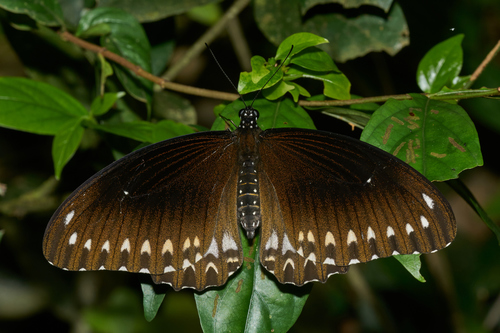
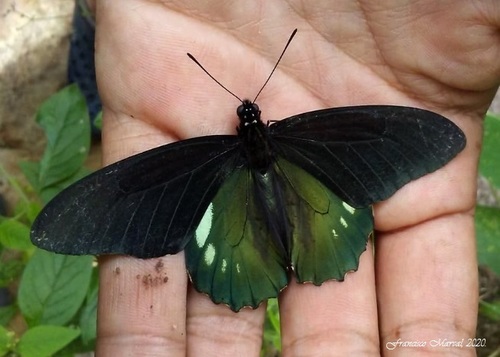
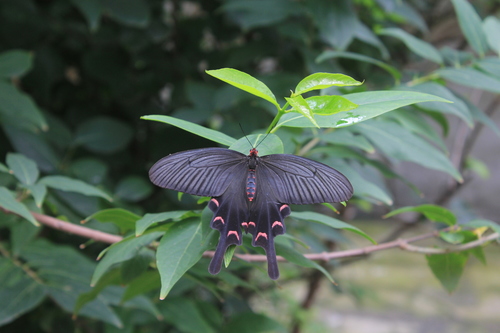
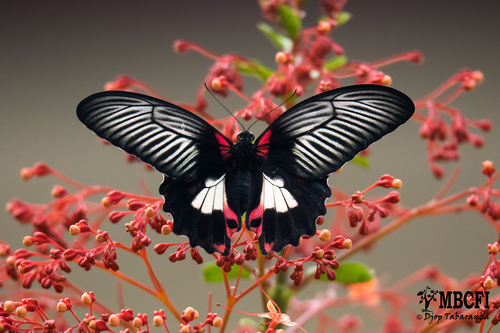
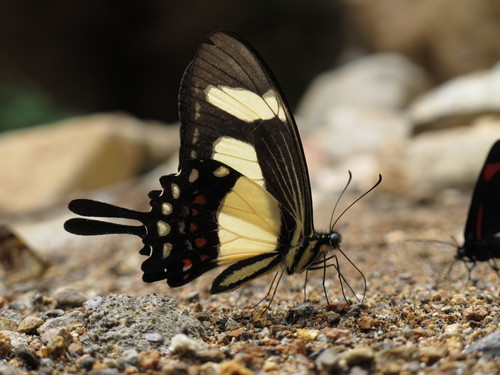
Scientific name: Papilio torquatus Cramer, 1777. This description is reproduced from Seitz. For the nominal male P. torquatus, the forewing band is interrupted between the second and third radial veins; a yellow spot that nearly fills this gap occurs rarely. On the underside of the hindwing, there is a row of red discal spots, with the last of these spots positioned proximally to the final submarginal spot. Females are very different from males, and mimic certain co-occurring Aristolochia-feeding Papilio species. Female wings are brown-black, with or without white patches on the forewing. The upper surface of the female hindwing has two rows of red spots; the proximal row is incomplete, with some spots paired and merged into two or three large patches. In males, the anal tergite is spatulate, and the harpe is broad and denticulate. The larva is shiny and polished, a trait shared by all closely related species. It is mottled with light colour, and has an irregular pale patch before its midsection; its overall colouration resembles bird droppings. The adult butterfly occurs in forests and areas adjacent to forests. Females are true woodland species, just like the Aristolochia-feeding Papilio species they mimic, while males are more active in open, sunny locations. The species ranges from Mexico to Brazil, and has not been recorded from temperate regions of South America including southern Brazil and Argentina. Papilio torquatus tolus Godman & Salvin: Males have a narrow forewing band, with a long anterior spot and a short second spot. Females have no white discal spots on the forewing, and two separate rows of red spots on the hindwing. The tail is long and spatulate in both sexes. This subspecies occurs in Mexico, and is apparently rare. Papilio torquatus tolmides Godman & Salvin: Males have a broader band than P. t. tolus, and a narrower tail. There are no spots, or only very small spots, before the upper angle of the forewing cell. Females are unknown. This subspecies is found in Chiriqui and Sevilla Island, and is also rare in collections. Papilio torquatus orchamus Boisduval: In males, spots before the upper angle of the forewing cell are small. The first long spot of the yellow band is the same length as the second, or slightly longer. Hindwing submarginal spots are usually very distinct. Females have a white spot crossing the forewing cell, an additional spot before the first median vein, and usually also a spot before the third radial vein plus an indistinct spot behind the first median vein. There are 4 to 6 large red spots on the hindwing, the cell contains a spot, and the tail is short and not spatulate. This subspecies occurs in Colombia and northern Venezuela. Papilio torquatus leptalea Rothschild & Jordan: In males, the yellow forewing band is narrower than the black marginal area, and narrower than in all other forms of this species. Spots before the apex of the cell are small. Hindwing submarginal spots are distinct. On the underside, the apex of the cell is black all the way to the base of the first median vein. The tail is spatulate. Females are similar to those of P. t. orchamus, but the white spot between the second and third forewing spots and the cell spot are smaller. This subspecies occurs in western Ecuador. Papilio torquatus torquatus Cramer (= pelaus Fabricius) (11b): In males, spots before the apex of the forewing cell are mostly larger than in other forms. The two subapical spots of the band are broad: the first is shorter than the second. The band is at least half again as broad as the black submarginal area. Hindwing submarginal spots are usually strongly darkened by black scaling. Females are very variable; the tail is always slender and commonly short. There are five principal female forms: female-form theras Rothschild & Jordan has a cell spot on the forewing, which does not extend across the cell, plus one or more spots on the disc; female-form caudius Hübner has no cell spot, but does have several discal spots, with the spot located between the first and second median veins being the largest; female-form patros Gray (11b) has no white spots on the forewing, and red patches on the hindwing; female-form flavida Oberthür (= flava Haase) resembles patros, but has yellow-white patches on the hindwing; female-form cleolas Rothschild & Jordan has no spots on the forewing, but has a yellowish white submarginal band on the forewing underside. These different female forms only co-occur in part; the first four are known from the Upper Amazon, and the fifth form, recorded from Bolivia, may also occur there. This nominal subspecies ranges across eastern and southern Venezuela, the Guianas, the Amazon basin, and the eastern slopes of the Andes of Ecuador, Peru and Bolivia. Papilio torquatus polybius Swainson (female = tros Hübner, trojanus Boisduval) (11b) inhabits Brazil (Mato Grosso) and Paraguay. In males, spots before the apex of the forewing cell are small, and submarginal spots on the underside are rather large. On the underside of the hindwing, the cell is entirely or almost entirely yellow, and the tail is broad. Only one female form is known: there is a spot in the forewing cell and a large patch between the first and second median veins, and the tail is spatulate with a rounded tip.