About Papilio thoas Linnaeus, 1771
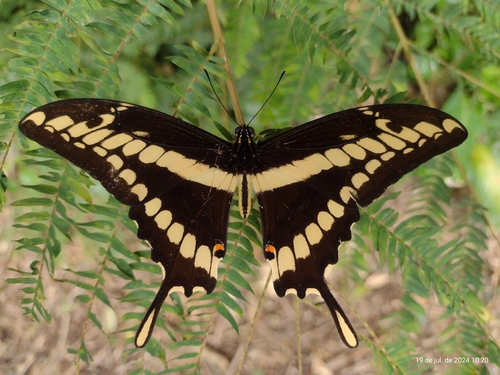
Papilio thoas, also known as the king swallowtail, is a large swallowtail species with a wingspan of 12 to 14 cm (4.7 to 5.5 in). It has narrow wings that are predominantly brown across both forewings and hindwings. A yellow band runs from the tip of the forewing, narrowing toward the back, and a row of yellow curved spots sits along the edge of the forewing underside. The hindwings are toothed, with a long tail that contains a yellow center. A row of yellow curved spots marks the edge of the hindwings, and a broad yellow band crosses the first half of the wing. Inside this yellow band is a black eyespot with blue-white scaling. Yellow markings are more distinct on the undersides of all wings. On the upper side of the wings, blue-white curved spots lie adjacent to the yellow curved spots, and the eyespot is only weakly visible on the upper side. The body of the king swallowtail is yellow. The spatulate tail of this species has a yellow spot in its middle. This species ranges from Texas and the West Indian Islands south to Buenos Aires, and is absent from the Lesser Antilles. It is common throughout its range, and flies in open country, gardens, and plantations. P. thoas is a very bold flier that often flies high in the air. Its larvae feed on plants in the Piperaceae family and Citrus. Multiple recognized subspecies of Papilio thoas have been described. The subspecies melonius R. & J. is found only on Jamaica; it lacks a cell-spot on the forewing upper surface, and has very large reddish yellow spots on the hindwing under surface. The subspecies oviedo Gundl. (= epithoas Oberth.) occurs on Cuba; its forewing yellow areas are more extensive, and have a deeper yellow tint, than those of other subspecies, on both the upper and especially the under surface. The subspecies autocles R. & J., found from Texas to Nicaragua, lacks a cell-spot and has pale yellow areas. The subspecies nealces R. & J. is distributed from Nicaragua to north-west Ecuador, and eastward to Trinidad and the Lower Orinoco. Its forewing always has a cell-spot, and its yellow tint is somewhat deeper than that of autocles, but less deep than the following subspecies; it is very common in Bogotá collections. The nominate subspecies thoas L. originates from the Guianas and the Lower Amazon. It is deep yellow, has a cell-spot on the forewing, and the first spot near the wing apex is usually small. The subspecies cinyras Men. is a large form that inhabits the Middle and Lower Amazon and the eastern slopes of Ecuador, Peru and Bolivia; its forewing submarginal spots are almost always absent. The subspecies brasiliensis R. & J., found in Brazil, Paraguay and north Argentina, is often even larger than cinyras. Its forewing cell-spot is either absent or small, and the first spot near the wing apex is mostly large and extended into a point. The subspecies thoantiades Burm. occurs in Argentina, especially in the province of Buenos Aires. It is a small form, usually with a narrow, pale yellow band. Papilio cresphontes, formerly classified as a subspecies of P. thoas, is very similar in appearance.