About Papilio scamander Boisduval, 1836
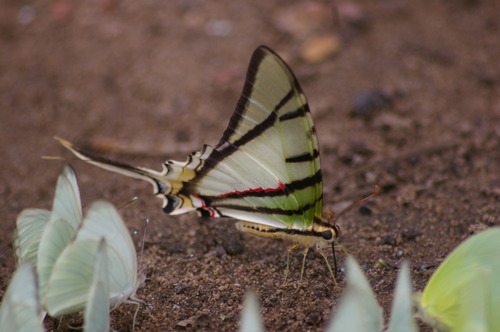
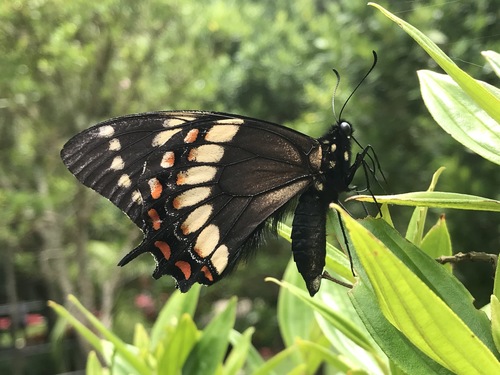
Papilio scamander, described by Boisduval in 1836, has the following characteristics. The cell of the forewing has no spot, while the cell of the hindwing sometimes has a small spot. A curved pale yellow discal band, broken into separate spots, appears on both wings. Males and females are extremely similar in appearance. The larvae and pupae of this species were described earlier in this work. This species is found in Brazil, where it is common in hilly regions, but does not occur everywhere across the country. There are three fully intergrading geographical forms of Papilio scamander. The first form, grayi Boisd., has an evenly curved submarginal band of spots on the forewing, and its discal band is widest toward the posterior end. On the underside of the hindwing, the red discal spots are separated from the discal band. This form ranges from Bahia to Paraná. The second form, eurymander Hopf., has its first 2 or 3 submarginal spots on the forewing positioned closer to the base of the wing than the other spots in the same row. Some of the submarginal spots on the hindwing are pale yellow. On the underside of the hindwing, the basal area is pale, and often partially yellowish; the red discal spots are either small or absent entirely. This form occurs in Santa Catarina and the adjacent districts of Rio Grande do Sul. The third form, the nominal scamander Boisd. (11d), has a more distinctly yellow discal band on the upper wing surface. The underside of its hindwing is pale yellow, with black veins, and has no red discal spots. The sides of the abdomen are pale yellow. This form is found in Rio Grande do Sul.