About Papilio rutulus Lucas, 1852
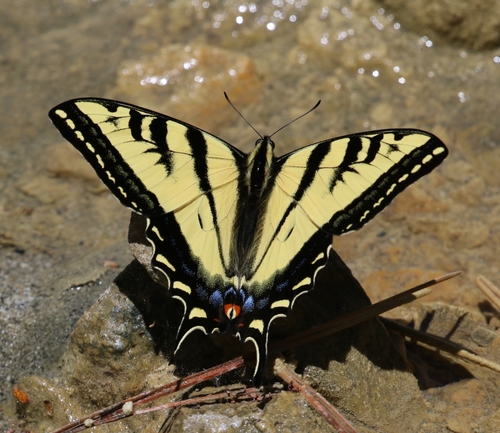
Papilio rutulus, commonly known as the western tiger swallowtail, is a large butterfly with a wingspan ranging from 7 to 10 cm (3 to 4 inches). Adults are brightly colored: their wings are yellow with black stripes, and they have blue and orange spots near the tail, plus the characteristic hindwing "tails" common to swallowtail butterflies. Young caterpillars look like bird droppings. As they molt, they eventually turn bright green, with a pair of large yellow eyespots that have black and blue pupils. The chrysalis is green during summer and dark brown during winter, and it resembles a piece of wood. Even in early development, caterpillars use defenses to protect themselves from threats. In the caterpillar stage, they mimic a snake using their tongue-like defensive organ called an osmeterium, plus two eyespots on the thorax, to scare off potential predators. This is an abundant species native to most of the west coast of North America, ranging from its northernmost to southernmost extents. It is regularly seen from northwestern Canada down to the southern tip of Baja California, and extends east through states including the Dakotas, Colorado, and New Mexico. While it primarily lives on the west coast, it can occasionally be observed as far east as central Nebraska and even Oklahoma; these individuals are typically rare strays outside of the species' usual range. Western tiger swallowtails are frequently found in urban parks and gardens, as well as rural woodlands and riparian areas, across western North America from southern California to southern British Columbia and Alberta. The species' life cycle starts when a female lays individual eggs one at a time on different host plants, which ensures larvae have enough space and resources to grow without overcrowding. After hatching, the caterpillar goes through multiple developmental stages. In early stages, the caterpillar uses bird dropping-like camouflage, and has eyespots to defend against predators. When the larval stage finishes, the caterpillar enters the pupal stage and forms a hard protective chrysalis, inside which it develops into an adult butterfly. The pupal stage lasts between a couple of weeks and several months, depending on environmental conditions. After completing metamorphosis, the adult butterfly emerges. Within a few hours of emerging, the butterfly's wings dry and expand enough to allow flight. In the adult stage, the butterfly focuses on reproduction and finding a mate. After the female is fertilized, the life cycle begins again.