About Papilio rumiko (Shiraiwa & Grishin, 2014)
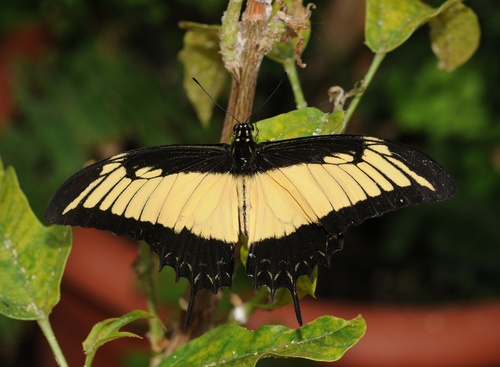
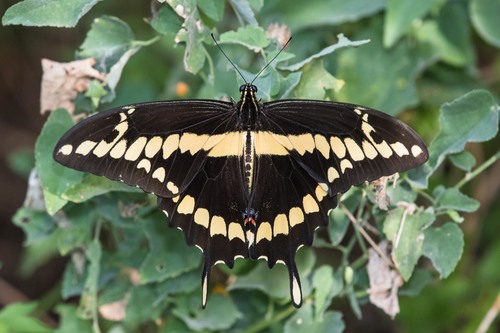
Papilio rumiko, also called the western giant swallowtail, is a species of swallowtail butterfly. This butterfly is found from the southwestern United States, through Mexico, El Salvador, Honduras, and Costa Rica, all the way to Panama. Its northernmost confirmed sighting is in northeastern Colorado. The forewings of Papilio rumiko measure 50–58 mm in length. Two maize-yellow bands are present on the forewings: a central band made of nine spots that runs from the wing apex to the basal third at the inner margin, and a submarginal band containing three to seven spots. Several smaller maize-yellow spots sit near the wing costa at the end of the discal cell. Inside or on the anterior edge of the yellow spots of the central band, there is a dark oval spot that matches the wing's background color. This dark spot varies in size, and can sometimes split a single yellow spot into two separate spots. The pale marginal spots located in the gaps between wing veins are small or almost completely absent. The hindwings have two maize-yellow bands that connect to the bands on the forewings. Near the hindwing tornus there is a maroon-red to orange-red eyespot, with a blue crescent marking positioned above it. The center of the hindwing tail tip is yellow. Female Papilio rumiko lay eggs singly on the young leaves and shoots of Zanthoxylum fagara, Ptelea trifoliata, Amyris texana, Casimiroa greggii, Ruta graveolens, and Citrus species. When first laid, the egg is pale yellow, and it gradually changes color to a dull orange-brown as it develops. First instar larvae are 3–5 mm long, with a yellow-brown head capsule. Their body pattern resembles bird droppings. Second instar larvae grow to 5–11 mm long, and have a uniformly brownish head. Third instars reach 11–16 mm in length, fourth instars reach 16–30 mm, and fifth instars reach 30–50 mm. When a late instar larva is startled, it lifts its head and inflates its thorax, which reveals eyespots on its metathorax. If disturbed further, it everts a red osmeterium from behind its head. Early instar larvae tend to evert their osmeterium immediately when disturbed, and the osmeterium of first instar larvae is yellowish. Pupation occurs in a pupa that is 26–36 mm long. The pupa has a mottled pattern of pale to greyish and dark brown, which matches the appearance of the tree or branch surface it is attached to. The overall darkness of the pupa is most often determined by the color of the surface it rests on.