About Papilio polyxenes Fabricius, 1775
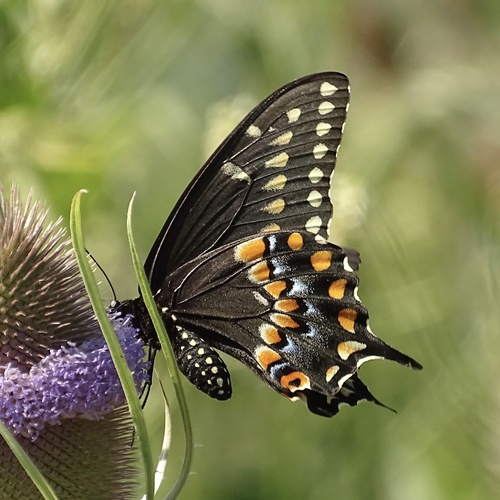
Papilio polyxenes, commonly called the (eastern) black swallowtail, American swallowtail, or parsnip swallowtail, is a butterfly found across most of North America. An extremely similar-looking species, Papilio joanae, lives in the Ozark Mountains region, and it appears to be closely related to Papilio machaon rather than P. polyxenes. This species is named for Polyxena, a figure from Greek mythology who was the youngest daughter of King Priam of Troy. Its caterpillar is often called the "parsley worm" because it feeds on parsley. Papilio polyxenes practices polyandry and uses a lek mating system, with no male parental care and set male display sites. This allows females to choose males based on these display sites, and males are the only resource females encounter at these sites. Papilio polyxenes ranges from southern Canada down to South America. In North America, it is more common east of the Rocky Mountains. It is typically found in open areas such as fields, parks, marshes, or deserts, and prefers tropical or temperate habitats. Females lay single eggs on host plants, usually on new foliage and occasionally on flowers. The egg stage lasts 4–9 days, the larval stage lasts 10–30 days, and the pupal stage lasts 18 days. The duration of these stages can vary depending on temperature and the species of the host plant. A 1985 study by Feeny et al. found that the survival of P. polyxenes eggs and larvae depends on the laying location, which was studied near Ithaca, New York. Eggs laid on wild carrot or parsnip plants were more likely to survive to the fifth instar than eggs laid on poison hemlock. Eggs laid on plants at elevations between 300 and 435 metres (984 to 1,427 ft) above sea level were more likely to survive than eggs laid at 120 metres above sea level. There were also significant differences in survival rates between early and late annual broods, and between different years. In all observed cases, predation was the primary cause of mortality. Papilio polyxenes uses a variety of herbs from the carrot family (Apiaceae) as food plants. Females choose larval food plants based on visual and chemical variation; host plant odor is one cue used to select landing sites for oviposition. Responses to these cues are innate, and feeding on a host plant as a larva does not increase an adult's preference for that plant. Recorded host plant species include: American angelica (Angelica atropurpurea), hairy angelica (Angelica venenosa), dill (Anethum graveolens), cutleaf waterparsnip (Berula erecta), spotted water hemlock (Cicuta maculata), Canadian honewort (Cryptotaenia canadensis), Queen Anne's lace (Daucus carota), wedgeleaf eryngo (Eryngium cuneifolium), fennel (Foeniculum vulgare), cow parsnip (Heracleum maximum), lovage (Levisticum officinale), cucumber magnolia (Magnolia acuminata), sweetbay magnolia (Magnolia virginiana), sweet cicely (Osmorhiza claytonii), long-styled sweet cicely (Osmorhiza longistylis), Canby's dropwort (Oxypolis canbyi), water cowbane (Oxypolis filiformis), parsnip (Pastinaca sativa), parsley (Petroselinum crispum), mock bishopweed (Ptilimnium capillaceum), rue (Ruta graveolens), water parsnip (Sium suave), roughfruit scaleseed (Spermolepis divaricata), yellow pimpernel (Taenidia integerrima), northern prickly ash (Zanthoxylum americanum), and golden alexanders (Zizia).