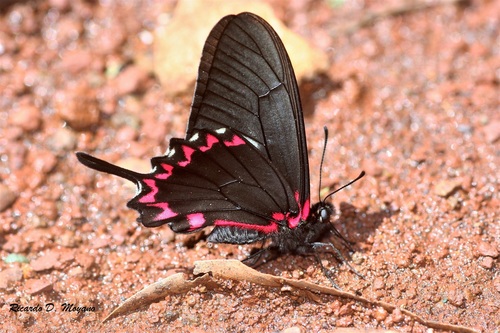
About Papilio polytes Linnaeus, 1758
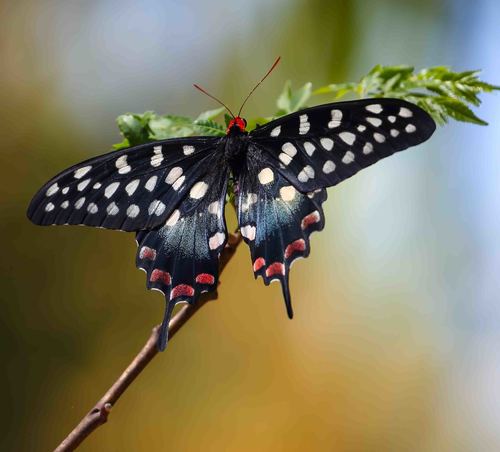
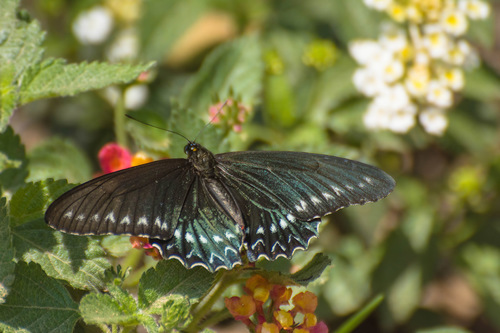
Papilio polytes Linnaeus, 1758 is a jet black butterfly with a row of white spots along the middle section of its hindwing, with a wingspan of 90 to 100 mm. Its range covers Pakistan, India, Bangladesh, Nepal, Sri Lanka, the Maldives, Myanmar, Thailand, Singapore, southern and western China including the provinces of Hainan and Guangdong, Taiwan, Hong Kong, the Ryukyu Islands of Japan, Vietnam, Laos, Cambodia, the Andaman Islands, the Nicobar Islands, eastern and Peninsular Malaysia, Brunei, Indonesia excluding the Moluccas and Irian Jaya, the Philippines, and Saipan in the Northern Marianas. This butterfly, the common Mormon, prefers lightly wooded areas, but can be found in all environments and at high elevations in hills. It is a common visitor to gardens, and is especially abundant in orchards growing its food plants, oranges and limes. It is most common during the monsoon and post-monsoon months. During its breeding life cycle, female common Mormons perch on exposed branches with their wings either open or closed. Males approach females from behind to court them, then slowly and elegantly settle into position. Larvae develop on a variety of species in the plant family Rutaceae, which includes Aegle marmelos (bael), Atalantia racemosa, multiple Citrus species (C. aurantifolia, C. grandis, C. limon, C. medica, C. sinensis), Glycosmis arborea, Murraya koenigii (curry leaf), and Murraya paniculata.