About Papilio peranthus Fabricius, 1787
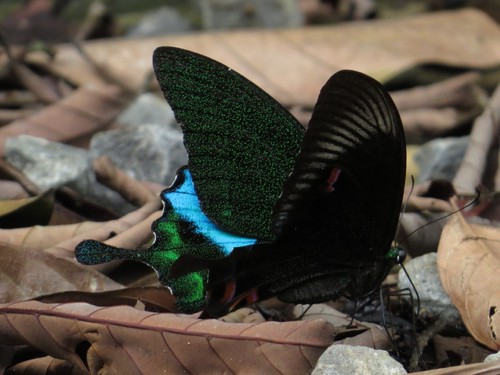
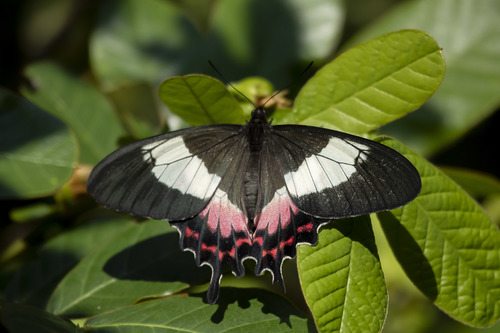
Papilio peranthus was first described by Fabricius in 1787. It is a very large butterfly species, with a wingspan ranging from 70 mm to 90 mm. Its wings have scalloped outer edges, and each hindwing bears a large, club-like tail. The upperside of its body and wings is primarily black, with the distal portion of the wings being green and the body having a green sheen. The underside is beige, with a brown basal section, and a line of chevron-shaped markings runs across the hindwings between the beige and brown areas. According to Seitz's description, roughly one-third to one-half of the area of both wings is bluish green, and this metallic-colored area never extends past the apex of the forewing cell. Before the distal margin of the forewing, there is a green band that is very broad at the anterior end and tapers significantly toward the posterior end. In males, the pilose stripes are mostly confluent, and are never all completely separated; at minimum, the stripe on the submedian fold is always united with the lower median stripe. Females are paler than males, particularly on the distal portion of the underside, and their metallic area is mostly a somewhat darker blue. The early life stages of Papilio peranthus are not currently known. In terms of habits, this butterfly resembles Papilio palinurus. There are multiple recognized subspecies or forms: The nominate form peranthus F. (37a). In males of this form, the green submarginal band of the forewing is as broad as, or broader than, the black discal band at the anterior end; the green basal area reaches to, or nearly to, the anterior angle of the cell. In females, the green scaling on the submarginal area of the forewing upperside is very sparse. The inner margin of the pale submarginal area on the forewing underside is mostly positioned basally to the subcostal fork. This form is found in Java. Form transiens Fruhst. (synonyms: kinesias Fruhst., fannius Fruhst., phoebus Fruhst.). The green area of this form is somewhat less extended than in the nominate peranthus, making the black discal band of the forewing broader. Just like in Javan nominate specimens, the green submarginal band of males only reaches the first median vein, and rarely is a green submarginal spot indicated below this vein. The light distal band on the forewing underside is positioned distally to the subcostal fork. This form ranges from Bali to Alor, with confirmed specimens collected from Bali, Lombok, Sumbawa, Flores, Adonara, Pantar, and Alor. Form intermedius Snell. (synonym: fulgens Rob.). The basal area of this form has denser scaling and is bluer than in both transiens and nominate peranthus. In females, the submarginal band of the forewing is distinctly green extending to the submedian, and in males, it continues to the second median vein or even all the way to the submedian. Anteriorly, this band is usually broader than in transiens. This form is found in Bonerate, Djampea and Kalao. Form baweana Hag.. Karl Jordan, who compiled this description, has only seen the two females originally described by Hagen. In these specimens, the blue-green basal area only extends to the anterior angle of the forewing cell; the green submarginal band is much narrower anteriorly than the black discal band, and its green scaling does not extend below the lower median. The costal and anal spots on the hindwing underside are large and pale yellow, and they also appear on the upperside in the single well-preserved specimen. The very light inner margin of the pale distal area on the forewing underside is positioned outside the subcostal fork, and before the middle, it curves basad even more distinctly than in females from Java. This form is found in Bawean. Form insulicola Rothsch. (37 b), from Saleyer. This form connects the preceding forms with adamantius, but most closely approaches adamantius. The costal margin of the forewing is more curved, and the distal margin is more strongly emarginate than in the preceding forms. In males, the green-blue basal area on the forewing does not reach quite to the upper median vein, and on the hindwing it reaches the apex of the cell; in females, it is even more reduced. The pilose stripes are broadly confluent, the green submarginal band is narrower than the black discal band. The upperside of the hindwing has almost no green submarginal spots, especially in males. The grey discal band on the forewing underside is close to the cell, and its inner margin crosses the stalk of the subcostal fork approximately halfway between the fork and the cell. Form adamantius Fldr. (synonym: macedon Wall.). This is a large form with long, falcate forewings and long hindwings with broad tails. The greenish blue basal area on the forewing reaches approximately to the lower median vein, and does not quite fill the cell of the hindwing. The green submarginal band is very broad, and in many specimens from North Celebes it is broader than in most specimens from the south of the island. The grey discal band on the forewing underside is broad and extends nearly to the cell. The pilose stripe on the first median vein is mostly isolated, and in many specimens the stripe on the submedian is absent. Females are very similar to males, with the basal area having slightly less dense scaling and the underside being paler. This form is found in North, Central and South Celebes, and is common, especially in the hills. No Gloss-Papilio specimens have yet been collected from the Sulla Islands. Description compiled by Karl Jordan in Seitz.