About Papilio palinurus Fabricius, 1787
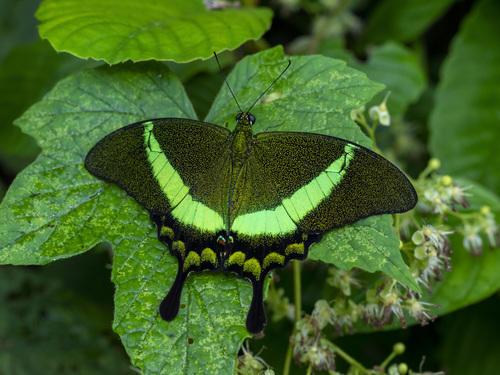
Papilio palinurus Fabricius, 1787 has a wingspan of about 8–10 centimetres (3.1–3.9 in). The dorsal sides of its wings are covered in a powder of green scales, with a background that ranges from dark greenish to black, marked by broad bright emerald green metallic bands. The undersides of the wings are black, with orange, white and blue spots along the edges of the hindwings, which bear extended tails at their tips. Seitz notes P. palinurus is similar to P. buddha, but has narrower bands across both wings; the distal-marginal area of the forewing is dusted with green, and the hindwing has large green submarginal spots. The grey band on the underside of the forewing is positioned very close to the cell, and is concave basally. The early life stages of this species are not known. According to Martin, these butterflies fly in wooded country, are very shy and agile, and occasionally enter gardens. They feed readily on the flowers of Ixora, Lantana, and similar plants, and are also often found at damp spots along forest paths. Hauxwell mentions that this species has a habit of flying close over water like a swallow, dipping its body in before hurrying away. This species ranges from Burma to Sumatra and Nias, northwards to the Philippines. The nominate subspecies P. palinurus palinurus F. (= regulus Stoll, brama Guer., tubero Fruhst., nikagoras Fruhst.) (35 b, c) has a very obliquely placed forewing band, which is at most 5 mm posterior to the end of the submedian. Both the forewing and hindwing bands vary in width across all localities, and most specimens from North Borneo have a slightly blue band, categorized as ab. solinus Fruhst. The under surface varies especially in the size of the hindwing submarginal spots. This subspecies occurs in Burma, Tenasserim, Malacca, Sumatra, and Borneo. Subspecies adventus Fruhst. from Nias differs from the nominate subspecies in both sexes, principally by having larger submarginal spots on the underside of the hindwing. Subspecies angustatus Stgr., found in Palawan, has a broader black area on the upper surface of the hindwing between the discal band and the submarginal spots, in both males and females, than P. palinurus palinurus and P. palinurus adventus. On the underside, the pale band of the forewing is less curved, and the pale marginal area of the hindwing is broader than in those two forms. Subspecies daedalus Fldr. (35 c) is the largest form of the species. The green discal band on the upper surface is broader than in the preceding subspecies, and the forewing band is less oblique; it is otherwise similar to angustatus. This subspecies occurs in the Philippines, and is thought to be present on almost all islands. According to Semper, it flies almost all year round, with peak activity in May and October. Subspecies nymphodorus Fruhst., from Bazilan, is said to be distinguished by a broad discal band on both wings and very large green submarginal patches on the hindwing. The describing author only examined one abnormal specimen, so the constancy of these diagnostic characters could not be confirmed. This entry was written by Karl Jordan for Seitz. The species can be found primarily in Southeast Asia, specifically in Burma, Peninsular Malaysia, Sumatra, Borneo, Indonesia (Simeulue, Island of Nias), and the Philippines (Basilan, Palawan, Balabac, Cuyo, Busuanga, and Dumaran). Papilio palinurus inhabits Asian primary forests.