About Papilio palamedes Drury, 1773
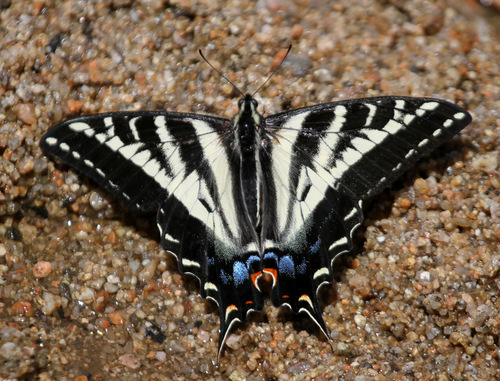
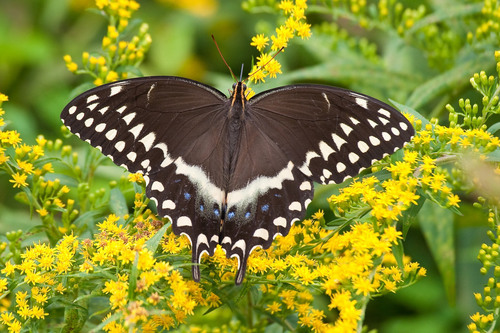
This species is scientifically named Papilio palamedes Drury, 1773, and is commonly known as the Palamedes swallowtail. The upperside of its wings is blackish brown. Both forewings and hindwings have a yellow postmedian band and a yellow submarginal band, and a yellow bar marks the end of the forewing cell. The underside of the wings is black; the forewing here also has a yellow postmedian band and a yellow submarginal band. The hindwing underside has four sequential colored bands: the first is cream, the second is orange, the third is blue, and the fourth is orange. A yellow streak runs along the hindwing inner margin, parallel to the insect's body. Its wingspan ranges from 4 and 1/2 to 5 and 1/8 inches, which is 11 to 13 cm. This species can be found in cypress swamplands, coastal swamplands, wet riparian forests, bay forests, and savannas across the southeastern United States and northeastern Mexico. Its longer tongue allows it to form a specific plant-pollinator relationship with the plant species Platanthera ciliaris in coastal-plain habitats. In its life cycle, males search for females by patrolling near forest edges and forest openings. During courtship, the male and female fly roughly one foot apart, moving slowly together in unison. The male then flies above and behind the female to disperse his pheromones, continuing this behavior until the female accepts mating. Females lay their pale greenish-yellow eggs one at a time on the leaves of host plants. The larva is green, with two false eyespots on the thorax, and small blue spots from the first to the eighth abdominal segments. It lives inside a leaf shelter. This larva is nearly identical to the caterpillar of the spicebush swallowtail Papilio troilus; the spicebush swallowtail larva differs by having larger false eyes, larger blue spots, and different host plant preferences. However, in the coastal Southeast, the spicebush swallowtail subspecies P. t. ilioneus shares redbay (Persea borbonia) as a host plant with Papilio palamedes. The green chrysalis has a whitish lateral stripe edged with brown along its upper edge, and two horns on the head. The chrysalis overwinters, and the Palamedes swallowtail produces two or three broods each year.