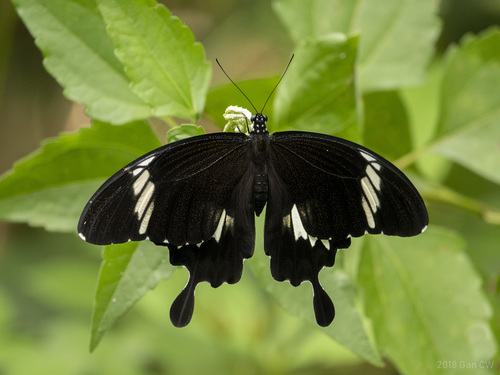
About Papilio nephelus Boisduval, 1836
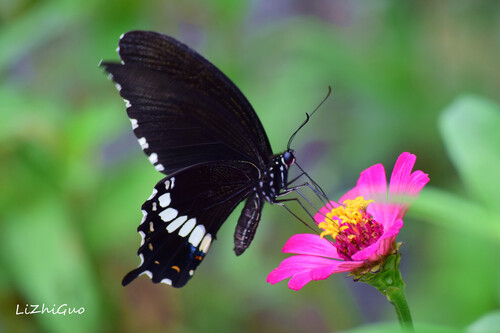
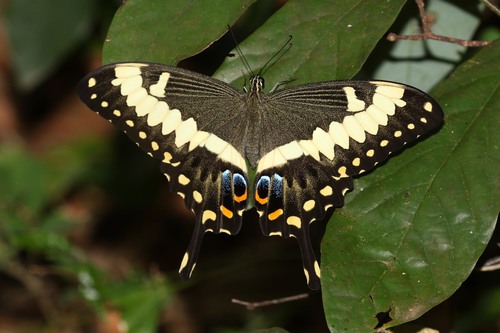
Papilio nephelus Boisduval, 1836 has a wingspan of about 10–12 centimetres (3.9–4.7 in). The base wing color is black, with a chain of white spots on the forewing and a large white or yellow area on the hindwing. The upper and underside of the wings are very similar. The hindwings have wavy margins and long tails, and both the thorax and abdomen are black. Papilio nephelus is superficially very similar to Papilio helenus, but the two species differ in both structure and color. On the upperside of the male forewing, the outer half is completely lacking a thick coating of short hairs. On the male's upperside, the wing is black with sprinkled yellowish-brown scales on the forewing, which form four longitudinal streaks on the cell and internervular streaks on the outer half. The upper discal white patch on the male hindwing is larger, formed by elongate broad streaks in interspaces 4 to 7 rather than 5 to 7, and there are no tornal or subterminal markings. On the underside, the ground color is a duller brownish black. The diffuse scaling on the forewing is arranged to form grey cellular and internervular streaks; the streaks in interspaces 1a and 1 are generally white instead of diffuse. The basal area of the hindwing is sprinkled with yellow scales that form three slender longitudinal lines in the cell. The upper white discal patch matches the one on the upperside, but the elongate white markings that make up the patch are clearly divided by black veins. Below the discal white patch, there is a small series of white spots in interspaces 1 to 3; the spot in 1 is generally, and the spot in 2 very often, tinged with ochraceous yellow. A complete subterminal series of ochraceous-yellow lunules is followed by narrow admarginal white spots. Antennae, head, thorax, and abdomen are black; beneath, there is a line of white on the palpi, and the thorax has some linear white markings. Females are similar to males. The upperside ground color is browner, and the cellular and internervular streaks on the forewing are more prominent. In many specimens, there is an obscure, diffuse whitish subcostal shading just beyond the apex of the cell. The underside is paler. The cellular and internervular streaks and the subcostal postcellular whitish patch on the forewing are more prominent. The posterior three short internervular streaks on the outer half of the wing are white, not diffuse. In a few specimens, there is a series of more or less conspicuous admarginal white spots, one in the middle of each interspace. Hindwing markings are similar to those of the male, but larger and more prominent. Antennae, head, thorax, and abdomen match the male, but the underside of the abdomen has lateral white markings. Known host plants for Papilio nephelus larvae include Toddalia asiatica, Euodia meliifolia, Fagra rhetsa, Citrus species, and Zanthoxylum rhetsa. This species occurs in the Asian portion of the Palaearctic realm, and also partially in both the Australasian realm and the Indomalayan realm. Its range extends from Nepal, Sikkim, and Assam to southern China, and from Myanmar to Thailand, Cambodia, and Indonesia. These butterflies primarily inhabit lowland primary forests.