About Papilio macilentus Janson, 1877
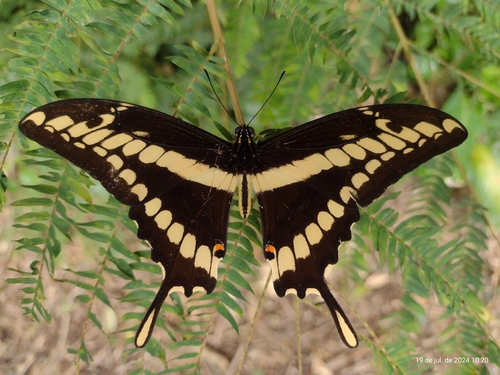
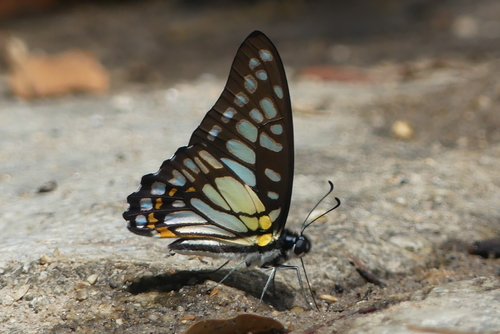
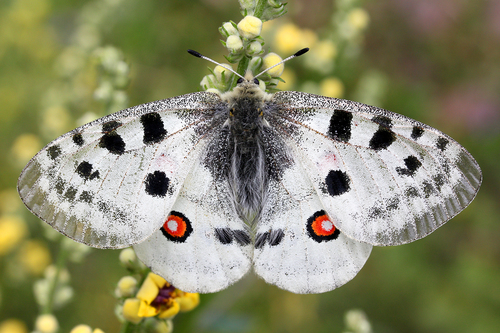
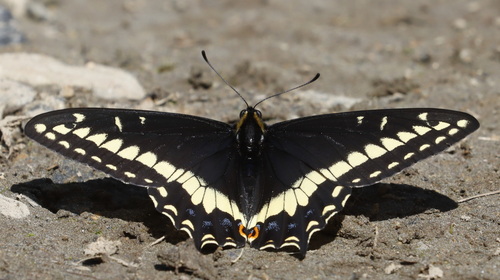
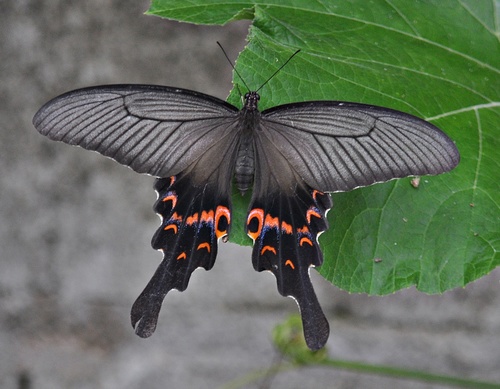
Papilio macilentus Janson, 1877 has a wingspan of 9–12 centimetres (3.5–4.7 inches). Its wings are black with red spots, wavy edges, and long tails on the hindwings. A row of small red spots runs along the outer edge of the hindwings, while a red eyespot is located at the inner edge. This species has some of the longest and most nicely-shaped tails of any member of the family Papilionidae. Males have a yellow transverse band in the overlapping area between the forewings and hindwings. The underside of the forewings is dark brown with black veins, and the head, thorax, and abdomen are all black. As originally described by Janson in 1877, this species is allied to Papilio protenor demetrius (then referred to as Papilio demetrius Cram.), but differs by having all wings narrower and much more elongated. The upper side of the primary forewings are dusky black, with very narrow black streaks between the nervures. Secondary hindwings have a strongly notched outer margin, with long, narrow black tails. The hindwing costa is pale yellow, with four small indistinct spots along the outer margin, and a broad dull red ring on the abdominal margin. On the underside, the primary forewings are paler and somewhat shinier than they are in P. demetrius, while the secondary hindwings have four lunular spots along the outer margin, an interrupted red ring on the abdominal margin, and a pale red spot near the anal angle. The original description records a wing expanse of 3 3/4 to 4 1/4 inches. The very long slender wings immediately distinguish this species from P. demetrius, the only species that resembles it in other characteristics. It was noted to be mountain-confined when first described, collected by Pryer and Jonas on Oyama. This species can be found in Japan, China, and Korea, where it inhabits valleys and forest margins.