About Papilio machaon Linnaeus, 1758
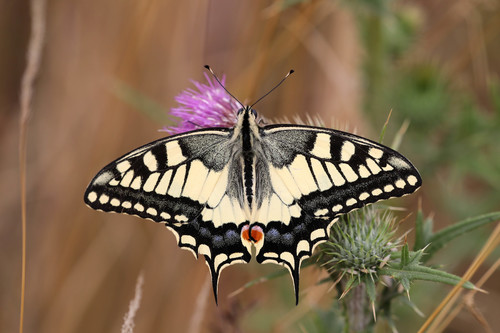
Adult Papilio machaon typically have yellow wings marked with black along the veins, and a wingspan measuring 65–86 millimetres (2.6–3.4 in). Both sexes have a pair of protruding tails on their hindwings. These tails resemble the tails of swallow birds, giving the butterfly its common swallowtail name. Just below each tail sits one red and six blue eye spots. Fully grown caterpillars of P. machaon reach a length of 45 millimetres (1.8 in). Young caterpillars look like bird droppings, which provides camouflage from predators. Caterpillars also have a large orange fork-like structure that protrudes behind their head for additional protection. This species can be distinguished from the sympatric Papilio hospiton, which shares its range on Corsica and Sardinia, by the longer hindwing tails. It can only be told apart from the Algerian species Papilio saharae by counting the segments on its antennae. This butterfly is found across the entire Palearctic region, ranging from Russia to China and Japan (including the Himalayas and Taiwan), and extends into Alaska, Canada, and the United States. It is therefore not restricted to the Old World, despite its common name. In Asia, it has been recorded as far south as Saudi Arabia, Oman, the high mountains of Yemen, Lebanon, Iran and Israel. In southern Asia, it occurs in Pakistan and Kashmir, northern India (from Sikkim to Assam, and Arunachal Pradesh), Nepal, Bhutan, and northern Myanmar. The species is widespread across most of Europe. In the United Kingdom, it is restricted to a small number of areas in the Norfolk Broads of East Anglia. It is the UK's largest resident butterfly; the larger monarch (Danaus plexippus) only occurs in the UK as a rare vagrant. Because P. machaon is widespread across Eurasia and often common, the species as a whole is not considered threatened. It is listed as vulnerable in the South Korean, Austrian, and former Soviet Union Red Data Books. In Armenia, the species has a stable population trend and is assessed as Least Concern. In several countries, P. machaon and its subspecies are protected by law. The nominal subspecies Papilio machaon machaon is legally protected in six provinces of Austria, the Czech Republic, Slovakia, Hungary, Romania, and Moldova. The full species is protected in the United Kingdom, and the subspecies verityi is protected in India. In late 2017, the Estonian Society of Lepidopterists selected P. machaon as one of several contenders for the title of National Butterfly of Estonia. Nearly 5,000 members of the public voted online, and P. machaon received 2,664 votes, winning the title by a large majority. Along with becoming the National Butterfly of Estonia, P. machaon was named the Butterfly of the Year for 2018, an annual honorary title given to a native butterfly species in Estonia. This butterfly has strong, fast flight, but often pauses to hover over flowering herbs and sip nectar. It commonly inhabits alpine meadows and hillsides, and males engage in the behavior of hilltopping, congregating near summits to compete for passing females. At lower elevations, it can be found visiting gardens. Unlike other swallowtail butterflies that specialize on plants in the Rutaceae family, this species mostly feeds on plants in the Umbelliferae family. Females lay eggs singly on host plants. For the British subspecies, milk parsley (also called marsh hog's fennel) is usually the only food plant used by caterpillars. Across the rest of Europe, Asia, and North America, the swallowtail uses a much wider variety of umbellifers, including wild carrot (Daucus carota), wild angelica (Angelica sylvestris), fennel (Foeniculum vulgare), and hogweeds (Heracleum). In the Maltese Islands, caterpillars feed on rue (Ruta chalepensis) in addition to umbellifers such as fennel. In Kashmir, where it is called the common yellow swallowtail, P. machaon inhabits alpine meadows in the Himalayas, ranging from 610 m (2,000 ft) in the Kashmir valley to 4,900 m (16,000 ft) in the Garhwal Himalayas. In Himachal Pradesh, India, it is only found above 1,200 m (4,000 ft), and in Sikkim it is only found above 2,400 m (8,000 ft). At lower elevations, these butterflies fly from March to September; at higher elevations, their flight period is limited by the short summer season. The British subspecies P. m. brittanicus is less mobile than its European continental relative and stays within or close to its fenland habitat. There are usually two to three broods per year, but in northern areas the species may only produce one brood annually (univoltine). In some locations such as the UK, some individuals pupate and emerge as adults in the same year, while others overwinter as pupae and emerge the following year. This mixed pattern is called partial bivoltinism. For the first part of their life, caterpillars retain the bird dropping appearance that works as an effective defense against predators. As caterpillars grow larger, they become green with black and orange markings. Their main defense against predators is the osmeterium, a pair of retractable, fleshy projections behind the head that can release a foul smell when disturbed to deter insects, though this does not work against birds.