About Papilio liomedon Moore, 1874
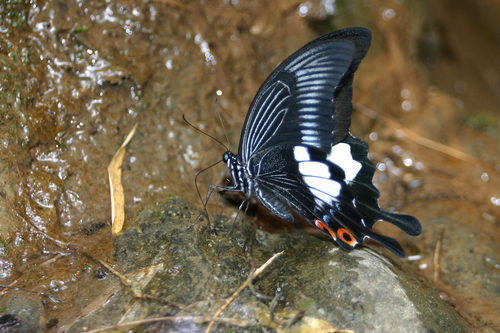
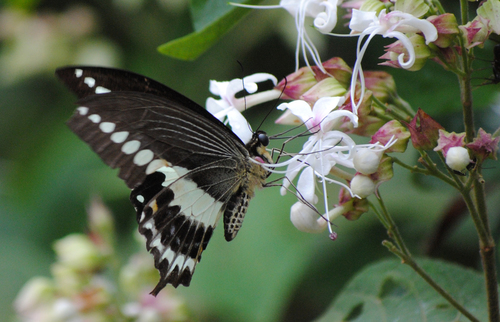
Papilio liomedon Moore, 1874 is similar to Papilio demolion, but can be distinguished primarily by the pale greenish-yellow band that crosses its wings. On the hindwing, this band starts from the middle of the dorsal margin, rather than just before the middle; additionally, the entire band is made up of separate spots on the forewing.
For both males and females: The upper side of the wings is similar to that of Papilio demolion. It differs on the forewing, in that all spots that make up the transverse discal pale sulfur-yellow band are distinctly separated from one another, and these spots are somewhat smaller in females. On the hindwing, the pale sulfur-yellow band is positioned farther from the base, with its outer edge extending beyond the cell; the submarginal lunules are somewhat larger and have sharper outer points. The underside of the wings is similar to that of P. demolion, but shares the same band differences on both wings seen on the upper side. On the hindwing, the discal black patches between the veins are shorter.
This species is distributed across the Western Ghats and the hills of southern India. It is common from May to August in Thenmala, Kollam district, southern Kerala. It generally inhabits semi-evergreen and evergreen tropical forests of the Western Ghats, and flies mainly during the monsoon months.
There are two to three broods per year. In Kodagu (Coorg), broods have been recorded from September to October, November to December, and April to May. In Karnataka, the species has been recorded in July and September. Males are thought to outnumber females. Davidson and Aitken documented the life history of this insect: one author observed a female P. liomedon laying eggs on a tender shoot of Acronychia laurifolia, a small jungle tree or shrub. Ten eggs were laid one on top of the other. Caterpillars emerged five days after laying, and five of these successfully developed into adult butterflies: one female and four males, consistent with the rarity of females of this species. Throughout their lives, these larvae remained gregarious; they would occasionally disperse to feed, but always returned to rest side by side on the upper surface of a leaf. The documented timing of development was: eggs laid 2 August, hatched 7 August; larvae cast (and ate) their skins 12 August, again 17 August, and again between 20 and 22 August. The most developed larva moulted again on 28 August, became a pupa on 2 September, and emerged as an adult on 15 September. The other mature larvae completed development within two days of this individual. Newly hatched larvae were oily yellow in colour, and bore many pairs of spiny points. These spines disappeared as the larvae aged; after the final moult, only the short fleshy processes on the second and last segment that are characteristic of the group remained, plus an additional curved pair on the ninth segment. After the final moult, the larva’s colour was a clear slaty-blue, which eventually changed to a greenish tint, with light brown markings very similar to those of other members of the group. The pupa is bent more sharply back from the middle of the thorax than the pupa of P. erithonius (i.e. P. demoleus). It is adorned on the thorax with a sword-shaped horn, fully three-eighths of an inch long, that is always bent either to the right or the left. The pupa’s colour is brown, or green and yellow depending on its location. Known food plants are Acronychia laurifolia and Evodia roxburghiana, both in the family Rutaceae.