About Papilio iswara White, 1842
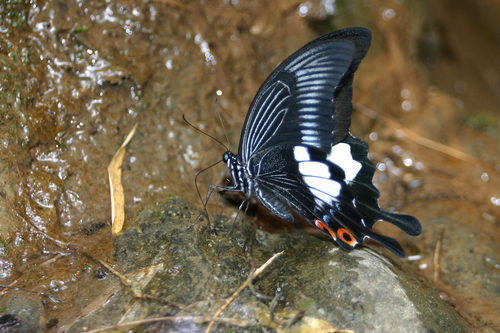
Scientific name: Papilio iswara White, 1842. This species is very similar to Papilio helenus. Its palpi are entirely white. The white area on the hindwing is made up of 4 patches, with the third patch being the largest. In males, this white area is smaller on the underside of the wing than on the upper side; the exception is the fourth white spot, which is larger on the underside. In females, there are two additional white spots between the fourth white spot and the red anal eye-spot; at least the upper of these two spots is also distinct in males. Most individuals only have 2 red submarginal spots, and both are large. These spots usually form a ring-spot when combined with the marginal spots. Unlike P. helenus, there is no red discal spot before the anal submarginal spot, and there are always 3 blue lunules in this position. The disc of the upper surface of the forewing is covered with pilose hairs. Females are paler than males, and their red submarginal spots are larger on both the upper and lower wing surfaces. The genitalia of P. iswara are similar to those of P. helenus, but the harpe is more spoon-shaped and the infra-anal processes are shorter. Like P. helenus, it occurs in wooded districts, principally in hilly areas. Its early life stages have not been documented. It is distributed from South Tenasserim to Sumatra and Borneo, and is only plentiful locally. The iswara subspecies (originally described by White) has a posteriorly broad white area on the hindwing. The yellow-red spots on the underside of the hindwing are large, and the anterior ring-spot is entire even in males. In females, the black pupils of both eye-spots are small. This form is found in Lower Tenasserim, the Malay Peninsula, Penang, Sumatra, and Banka. Specimens from Sumatra and Banka are similar to the next described form. The araspedes Fldr. form is on average smaller than the nominal iswara form, though the largest araspedes specimens are much larger than the smallest iswara specimens. The white area of the hindwing is usually not as broad as in nominal iswara, and is more pointed toward the posterior. The red spots on the underside of the hindwing and the fourth white discal patch are smaller in this form. One of the two female specimens held at the Tring Museum, collected from Lawas, North Borneo, has three thin red submarginal lunules on the anterior portion of the underside of the hindwing. It also has a fine curved red longitudinal mark before the first median, and traces of an additional submarginal spot before the tail, meaning at least a complete row of submarginal lunules is indicated in this specimen. This form is found in Borneo and the Natuna Islands. The two specimens examined from Bungaran, Natuna, are slightly similar to the nominal iswara form. Author: Karl Jordan in Seitz.