About Papilio hospiton Géné, 1839
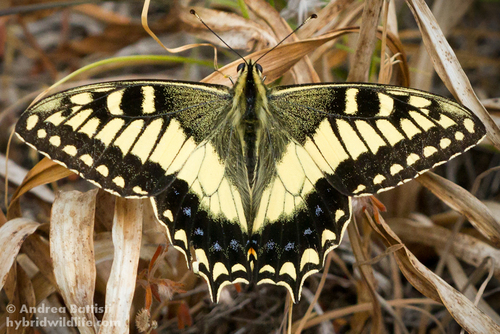
Papilio hospiton, commonly known as the Corsican swallowtail, is a butterfly species belonging to the family Papilionidae. It is exclusively found on the Mediterranean islands of Corsica and Sardinia. This is a medium-sized swallowtail butterfly with a wingspan ranging from 72 to 76 millimetres, or 2.8 to 3.0 inches. It has short black-and-yellow patterning, short tail structures on its hindwings, and additional blue and red markings. Males and females of this species look identical. The Corsican swallowtail is similar in appearance to Papilio machaon, but it can be distinguished by having more rounded wings. Instead of a full tail, its hindwing has a short tooth-like projection, it has more extensive black coloring, and this black area is more densely dusted with yellow than in P. machaon. The caterpillar of Papilio hospiton is green with black stripes and dotted with small yellowish-red punctures; its black coloring is more extensive than that of the Papilio machaon caterpillar. The chrysalis is green, and its abdominal tubercles are more prominent than those of P. machaon. This species lives in mountainous habitats between 400 and 1,500 metres, or 1,300 and 4,900 feet, above sea level on Corsica and Sardinia. Its recorded food plants belong to the family Umbelliferae, and include fennel, giant fennel (Ferula communis), Corsican rue (Ruta corsica) and Peucedanum paniculatum, though some of these feeding records are disputed. Papilio hospiton is bivoltine, producing two broods per year in May and August. The main threats to the Corsican swallowtail are habitat destruction, loss of its food plants, and excessive over-collecting.