About Papilio helenus Linnaeus, 1758
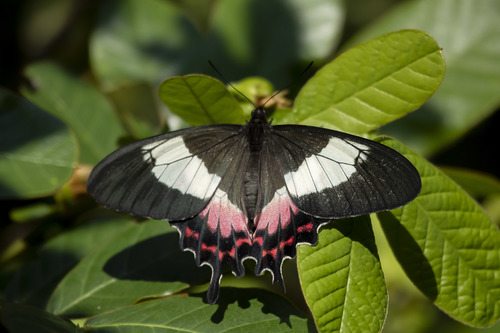
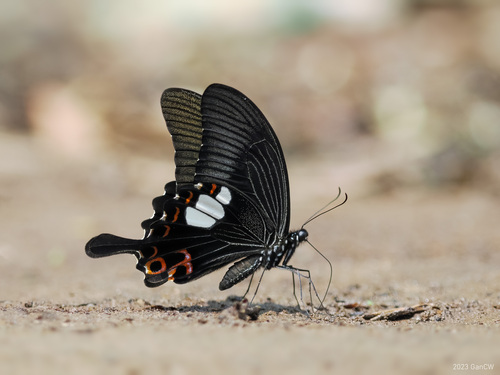
This species is Papilio helenus Linnaeus, 1758. Description of the male: The upper side is a rich brownish-black, with cilia alternating with white. The fore-wing has slender longitudinal streaks of golden-yellow scales inside the cell, and broad hairy-scaled streaks between the outer veins; the lower base of the wing is also sparsely speckled with golden-yellow scales. The hind-wing has an upper discal cream-white patch made up of three portions: a short, nearly quadrate portion in the costal interspace, and two large, elongated lower portions in the subcostal interspaces. A small number of white or grey scales are also present below the lower portion of the patch. At the anal angle, there is a dark purple-red circlet that generally partly encloses a round black spot. This is followed by a lower submarginal series of three, sometimes four, more or less visible purple-red incurved lunules; the first, or lower lunule sometimes forms a circle around a black spot. In some specimens, the lower lunule is not prominent, and in others, all of these latter lunules are completely gone. The underside is paler. The fore-wing has prominent slender greyish-white scaled streaks in the cell and broad scaled streaks along the outer veins. The hind-wing has the upper basal area speckled with greyish-white scales, three similar slender greyish-white scaled longitudinal streaks within the cell, and white scales at the base of the median and submedian vein. The upper discal white patch is made of three portions that are smaller than those on the upper side. The anal ocellus and complete series of submarginal lunules are dark red. An inner sub anal confluent lunule is also present in the lower median interspace. The anal and sub anal lunules are speckled with violet-blue scales. Beyond these, there is a marginal row of more or less defined red-and-white scaled lunules. Description of the female: The upper side and underside are similar to the male, except that the base of the hind-wing is paler. The body is brownish-black; the collar, front of the head, and palpi have white spots; the tegulae have a white fringe; the legs and antennae are black. Range: Papilio helenus is rarely found in Sri Lanka, southern and north-east India, Nepal, Bhutan, Bangladesh, Myanmar, Thailand, Laos, Cambodia, Vietnam, southern China including Hainan and Guangdong province, Taiwan, southern Japan, South Korea, the Ryukyu Islands, peninsular and eastern Malaysia, Brunei, the Philippines, and Indonesia including Sumatra, Java, Bangka, Kalimantan, and the Lesser Sunda Islands except Tanimbar. In India, it occurs along the Western Ghats from Kerala to Gujarat, and also in the Palni Hills and Shevaroy Hills; in the north, it occurs from Mussoorie eastwards to north-east India and into Myanmar. Life cycle: This butterfly flies throughout the year in southern India.