About Papilio glaucus Linnaeus, 1758
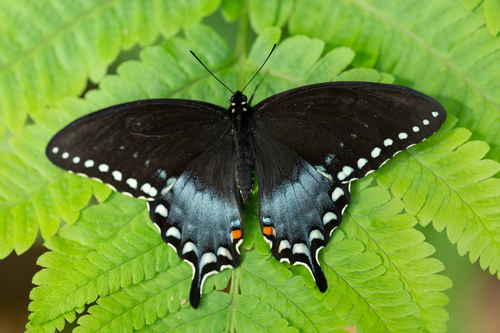
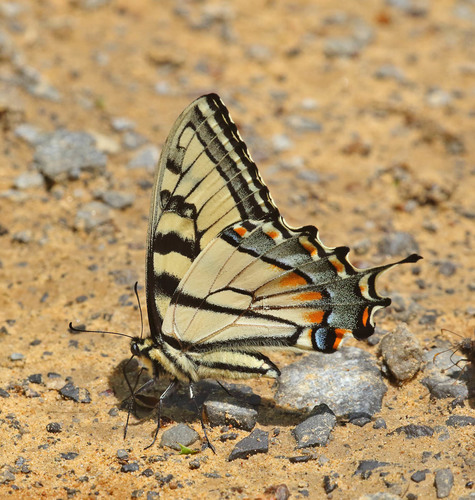
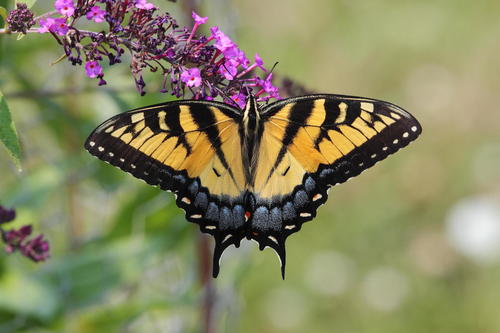
Papilio glaucus Linnaeus, 1758 is a swallowtail butterfly with a wingspan ranging from 7.9 to 14 cm (3.1 to 5.5 in); females are the larger sex, and individuals from southern regions are larger than those from the north. Males are yellow with four black "tiger stripes" on each forewing. The outer edge of the forewing is black, marked with a row of yellow spots, and the veins are outlined in black. The postmedian area of the hindwing is black with yellow spots along the margin, while the inner margin of the hindwing holds small red and blue spots. A broken yellow bar split into spots runs along the ventral forewing margin; this mark is present in both sexes and is used to distinguish P. glaucus from its close relatives. Females are sexually dimorphic. The yellow morph differs from the male by having a blue postmedian area on the dorsal hindwing. In the dark morph, all areas normally yellow are replaced with dark gray or black. The bluish postmedian area on the ventral hindwing has one row of orange spots, and a faint shadow of the "tiger stripes" can be seen on the underside of some dark females. P. glaucus is one of the few papilionid species known to produce gynandromorphs. Most bilateral gynandromorphs are hybrids of P. glaucus and P. canadensis found along hybrid zones, while color mosaics occur in the central part of the species' range. This butterfly is distributed across the eastern United States, ranging from southern Vermont to Florida, west to eastern Texas and the Great Plains. It is common throughout most of its range, though it is rarer in southern Florida and entirely absent from the Florida Keys. A single specimen was collected in County Wicklow, Ireland in 1932, and is believed to be an accidental introduction from North America. P. glaucus can be found nearly anywhere deciduous forests grow. Common habitats include woodlands, fields, rivers, creeks, roadsides, and gardens, and it will also stray into urban parks and city yards. Because it has adapted to many different habitats and host plants, P. glaucus is a habitat generalist and is not considered threatened. It is regarded as one of the most polyphagous of all swallowtail species, a trait likely linked to its genetic traits and specialized detoxification abilities. However, at the northern range overlap between P. glaucus and Papilio canadensis, P. glaucus survives very poorly through its first larval instar when it settles on quaking aspen (Populus tremeloides). Its survival rate under these conditions is approximately 15%, while P. canadensis thrives on this food plant. Adult P. glaucus are visible from spring to fall, with exact activity dates varying by location. In the southern part of the range, they can be seen from February to November; in the north, they are active from May to September. P. glaucus produces two broods per year in the north and three in the south; the first broods of each year produce the smallest adult individuals. In its life cycle, the butterfly may have one or two generations per year in the north, while southern areas may support three generations. Stage durations are as follows: Eggs take three to five days to hatch; the caterpillar goes through five instars to reach maturity; the pupal chrysalis stage lasts nine to eleven days, or extends through winter for hibernation.