About Papilio gigon Felder & Felder, 1864
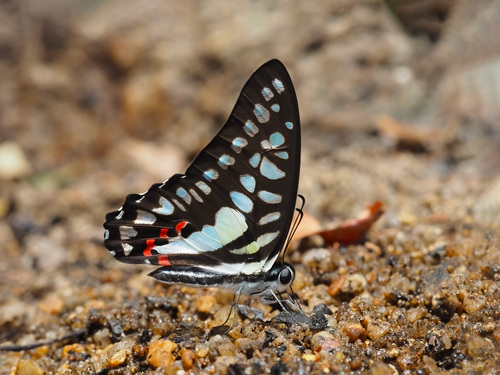
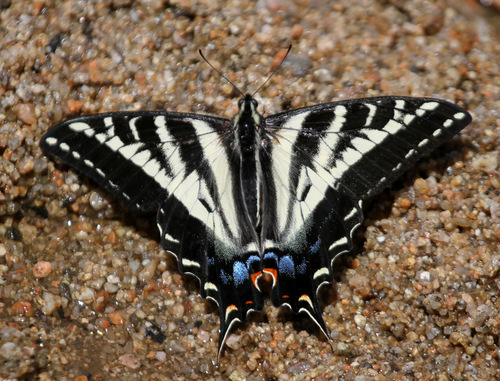
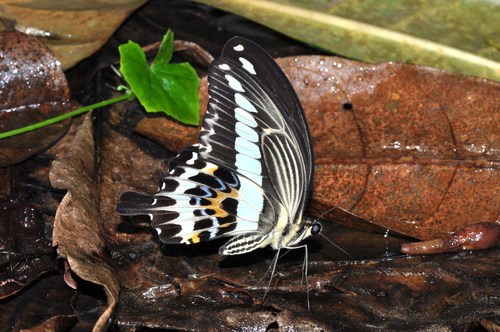
Papilio gigon is a butterfly species belonging to the family Papilionidae. It is restricted to islands in eastern Indonesia, including Sulawesi, Sula, and Talaud, and is common in the areas where it occurs. Its wingspan ranges from 120 to 130 mm. The two sexes are similar in appearance, with females being paler than males. It is much larger than Papilio demolion. Like many butterflies native to Celebes (now Sulawesi), the costal margin of its forewing is strongly curved, and the forewing cell is correspondingly strongly widened. The cell of the hindwing also differs in shape from that of P. demolion: the subcostal vein originates much further distally than in P. demolion, and the hindwing band is positioned basally to the subcostal. The apex of the underside of the hindwing cell is margined with yellow. In terms of genitalia, it is most closely related to P. liomedon. Young larvae are olive-green; the prothorax and anal segment each have a pair of long tubercles. A white stripe runs along each side of the body, from above the legs between the head and anus. The middle of the body has a broad, dentate white transverse band that connects to the lateral stripes. Full-grown larvae are blue-green. They have a black transverse band on the 3rd body segment, a transverse band that is light brown on its upper half at the hind margin of the 4th segment, a third transverse band on the 7th and 8th segments, and a triangular lateral spot on the 9th segment. In a larva observed by Kuhn on Bangkai Island, the first band was dark brown and spectacle-shaped. The pupa is light grass-green, with a long, curved thoracic horn. A brown lateral stripe runs from the horn to the anal extremity, and an identical brown central stripe runs along the back. For the nominate form gigon Fldr. (= cresphontes Bdv. nec Cr.), on the underside of the hindwing, the first black distal mark is approximately as broad at the costa as the yellowish white band. The yellow margin at the apex of the cell is usually narrow and always extends into points at the veins. This form occurs across the whole of Celebes; author Jordan stated he did not know if specimens from Siao and Bangkai match those from Celebes. The nominate form is common, and has very rapid flight. The subspecies neriotes Rothsch. is found in Talaut and Sangir. The submarginal spots on the underside of the forewing are confluent; this trait sometimes also occurs in nominate gigon, but in that case the veins of this band are more broadly dusted with white-yellow towards the base than in neriotes. The marginal spots on the underside of the hindwing are larger in both sexes of neriotes than in nominate gigon. The subspecies mangolinus Fruhst. occurs on the Sulla Islands (Mangola and Besi). On the underside of the hindwing of mangolinus, the yellow margin of the cell is always broader than in the other two forms, and the first black discal patch is smaller than in both gigon and neriotes. Mangolinus is very similar to Papilio noblei. The larvae of Papilio gigon feed on Citrus species, Euodia latifolia, Euodia roxburghiana, and Glycosmis pentaphylla.