About Papilio dialis (Leech, 1893)
Scientific name: Papilio dialis (Leech, 1893)
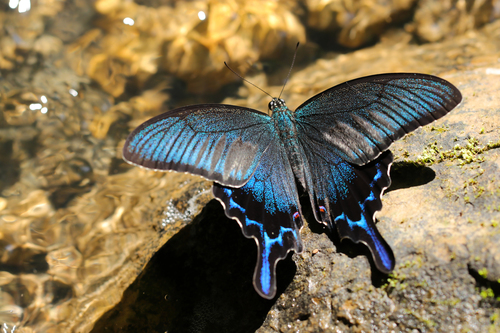
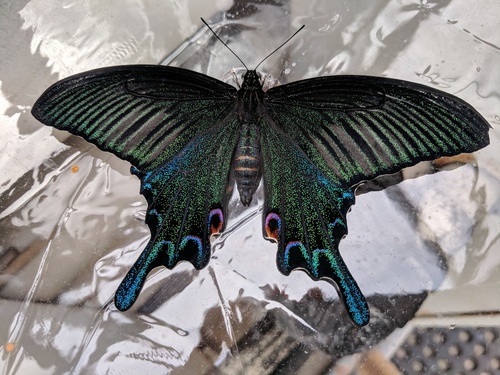
Description: The body is black, covered in fine metallic dust-like scales on the upper side. The upper surface of the wings is dusted with green scales. The hindwing has a blue tinge in its costal region, lacks a metallic patch, and has a red ring at the anal angle. The tail is absent, stunted, or as long and broad as the tail of Papilio bianor, with all intermediate forms present between these states.
The under wing surface is similar to that of Papilio bianor, but the dark markings on the forewing are always less extensive than they are in matching forms of Papilio bianor from the same region. In males, the scent-streaks are always narrow, widely spaced, and much more uniform in width than those of Papilio polyctor, a species where the scent stripes are also spaced apart. Females have less dense metallic scaling than males, and have a red submarginal spot on the upperside of the hindwing behind the second median vein.
The early life stages of Papilio dialis are unknown. The species is rare in insect collections. Only collector Hans Fruhstorfer has ever captured even a small series of specimens. Fruhstorfer found the insect near human settlements, on refuse heaps before and among huts, and on moist sand along river banks. While the butterfly is very shy, it often returns to the same spot after being disturbed. It always keeps its wings closed when feeding. Its circling, hovering flight creates an impressive sight thanks to its graceful movements, as recorded by Fruhstorfer.
Papilio dialis is distributed from the Shan States to Central China and Formosa. The genitalia of most species in this group are so similar that almost no clear distinguishing differences can be identified between them.