About Papilio demoleus Linnaeus, 1758
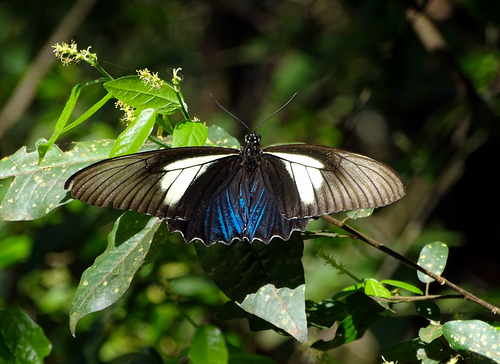
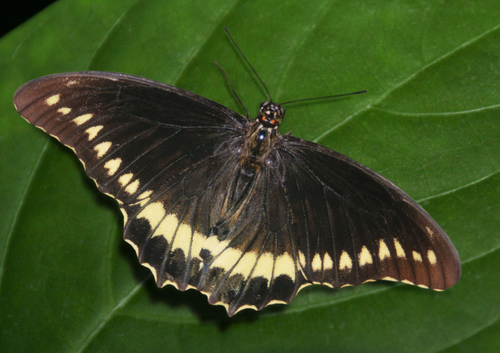
This is a description of Papilio demoleus Linnaeus, 1758, a tailless swallowtail butterfly with a wingspan of 80–100 mm. On the upper side of its wings, the background is black, with a broad, irregular yellow band that is broken on the forewing. There are many additional irregular spots across the wings, and the upper hindwing has a red tornal spot bordered by blue. As caterpillars age, their consumption of leaf tissue increases. A detailed 1905 description by Charles Thomas Bingham follows: On the upper side of the wings, the ground colour is black. On the forewing, the base below the cell and the basal half of the cell are covered in yellow scales that form more or less complete transverse dotted lines. There are two outwardly oblique yellow spots inside the cell, a curved spot at the cell's upper apex, one spot at the base of interspace 8 and another beyond it, and an irregularly sized and arranged discal transverse series of cream-yellow spots running from interspace 1a to 8. This series is interrupted in interspace 5, and the spot in interspace 7 is doubled. After this series comes a sinuous postdiscal series of spots, then an admarginal terminal series of smaller spots. In many specimens, the black ground colour between the discal and postdiscal series is dusted with yellowish scales. On the hindwing, the base and a width-decreasing edge along the dorsal margin are dusted with yellow scales. Next comes a broad, irregular medial yellow band, a sinuous postdiscal series of outwardly notched yellow spots, then a terminal series of smaller similarly coloured spots matching those on the forewing. The inner margin of the medial band curves inward, while its outer margin is very irregular and uneven. The band does not reach the apex of the cell, but beyond the cell there are one or more cream-yellow spots, and the black ground colour is dusted with yellowish scales. Finally, at the tornal angle there is an oval ochraceous-red spot that is notched on its inner side in females; in both sexes, this spot is topped by a blue lunule. In interspace 7, between the medial band and the postdiscal spot, there is a large ocellus-like spot of the black ground colour that is more or less dusted with blue scales. On the underside of the wings, the ground colour matches the upper side, but the cream-coloured markings are paler and noticeably larger. Markings differ from the upper side: on the forewing, the basal half of the cell and the wing base below the cell have cream-coloured streaks that merge at the base, there are irregular ochraceous spots in interspaces 5 to 8, and the discal series of spots is complete and not interrupted in interspace 5. On the underside of the hindwing, the black area at the wing base and along the dorsal margin is largely centered with pale cream-colour. The ocellus in interspace 7, the apex of the cell, and the black ground colour between the medial band and postdiscal markings in interspaces 2–6 are centered with ochraceous and margined with blue. Antennae are dark reddish brown, with an ochraceous tint on the inner side near the club. The head, thorax, and abdomen are dusky black; the head and front of the thorax are streaked with cream-yellow. On the underside, the palpi, thorax, and abdomen are cream-yellow, with lateral longitudinal black lines along the abdomen. P. demoleus is likely the most widely distributed swallowtail butterfly in the world. Its recorded range includes Syria, Israel, Iraq, Oman, United Arab Emirates, Kuwait, Qatar, Iran, western and possibly eastern Afghanistan, the South Asian Subcontinent (India including the Andamans, Bangladesh, western Pakistan, Sri Lanka, Nepal), Myanmar, Thailand, the Philippines, Cambodia, Vietnam, southern China (including Hainan, Guangdong province), Taiwan, Japan (only rare strays), Malaysia, Singapore, Indonesia (Kalimantan, Sumatra, Sula, Talaud, Flores, Alor and Sumba), Papua New Guinea, Australia (including Lord Howe Island), Solomon Islands, Hawaii, and possibly other Pacific Ocean islands. The Southeast Asian subspecies Papilio demoleus malayanus recently established an abundant non-native population on Mahé in the Seychelles. The species was probably accidentally introduced to Mahé a few years ago, with first records in November 2016. Further dispersal to other granitic islands of the Seychelles archipelago, such as Praslin and La Digue, is expected. Formerly absent from Borneo, it is now one of the most common papilionid butterflies in Sabah and Sarawak (Malaysian Borneo), Kalimantan (Indonesian Borneo), and Brunei. In recent years, the butterfly has spread to the island of Hispaniola (occupied by the Dominican Republic and Haiti) in the Western Hemisphere, and then onward to Jamaica, Cuba, the northern Lesser Antilles, and Puerto Rico. The Dominican population originates from Southeast Asia, but the method of arrival there is unknown. A pupa of this species was reported on Key West, Florida by an iNaturalist user in September 2022. The species' very large range indicates it tolerates and adapts to a wide variety of habitats. It occurs in savannahs, fallow lands, gardens, evergreen and semi-evergreen forests, and prefers habitats near streams and riverbeds. In India, it is mostly found in the plains, but also occurs on the hills of peninsular India and up to 2,100 m (7,000 feet) in the Himalayas. It is common in urban gardens and can also be found in wooded country. P. demoleus is a very successful invasive species; its spread is attributed to its strong flight ability, increased urbanisation and agricultural land use that open new areas for dispersal, and greater availability of food plants. In Asia, the larval food plants of P. demoleus belong to the family Rutaceae. In Australia and Papua New Guinea, the butterfly also feeds on host plants from the family Fabaceae.