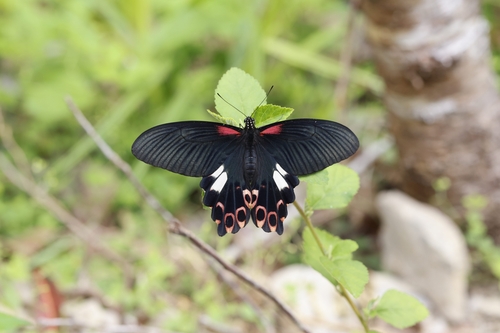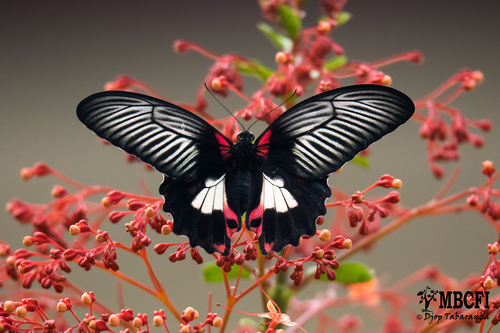
About Papilio deiphobus Linnaeus, 1758
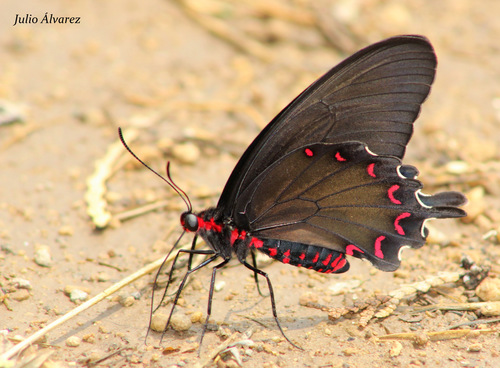
Papilio deiphobus is a species of swallowtail butterfly belonging to the Papilioninae subfamily. It has a wingspan ranging from 130 to 160 millimetres (5.1 to 6.3 inches), and is found across Indonesia from the Moluccas to Sulawesi. It is very closely related to Papilio rumanzovia. Its forewing is far less falcate in shape than that of P. rumanzovia. Individuals may be tailed or tailless, and the patches on its under surface are just as brilliantly red as those of P. rumanzovia. On the upper surface of a male's hindwing, there is a broad band made of light blue stripes placed before the distal margin; the inner margin of this band is uniformly concave. Females have thin white fringe-spots on their forewings. The red admarginal spots on the female's hindwing, especially the anterior ones, are broadly confluent with the white fringe-spots. This is a quick-flying butterfly that is particularly common near human settlements, where Citrus trees are grown in gardens; it is rarer in forested areas. At the time of this description, the larva of P. deiphobus had not yet been described, and was considered probably similar to the larva of Papilio memnon. Additional records note its presence on the Moluccas and Waigeu, and possibly also in New Guinea. Several subspecies and morphs are recognized. The subspecies deiphontes Fldr. (29a) is tailless, but has a distinctly projecting tooth at the third radial. The blue stripes on the upper surface of its hindwing are densely scaled, more or less united in pairs, and the resulting patches are distally emarginate. Female deiphontes have forewings that are brownish black from the base to the second median, and lighter beyond this point, with brownish black streaks between the veins. On the under surface of the female forewing, only the light streaks located behind the second median are white at the base; all other streaks are darkened. The hindwing of deiphontes always has a white discal area, with metallically blue scaling anteriorly near the apex. A morph, ab. flava Oberth., has yellowish rather than red spots on the hindwing, and occurs in both males and females. This subspecies is found on Morty, Halmaheira, Ternate and Batjan. Subspecies deipylus Fldr. is tailed in both sexes. The male's hindwing band matches that of deiphontes, but the black interneural stripes are overall even thinner. The female is also tailed, and has a darker forewing than deiphontes. The posterior grey-brown stripes on the female forewing are not whitish basally, and the white cell-spot on the hindwing is only faintly indicated. This subspecies is found on Waigeu, and possibly also in Dutch New Guinea. The nominate subspecies deiphobus L. (female = alcandor Cr.) (28a, b) is tailed. In males, the grey-blue stripes on the upperside of the hindwing are positioned much further from the distal margin than in the previously listed forms, and are mostly also much thinner. In females, the portion of the forewing disc located below the cell, as well as the adjoining part of the cell itself, is much lighter; the markings on the hindwing vary individually among specimens. A morph, ab. hypoxanthos Rob., occurs in both males and females, and has all red markings replaced by yellow. The nominate subspecies is common on Ceram, Saparoea, Amboina, Buru and Obi. The larvae of Papilio deiphobus feed on Citrus species.